
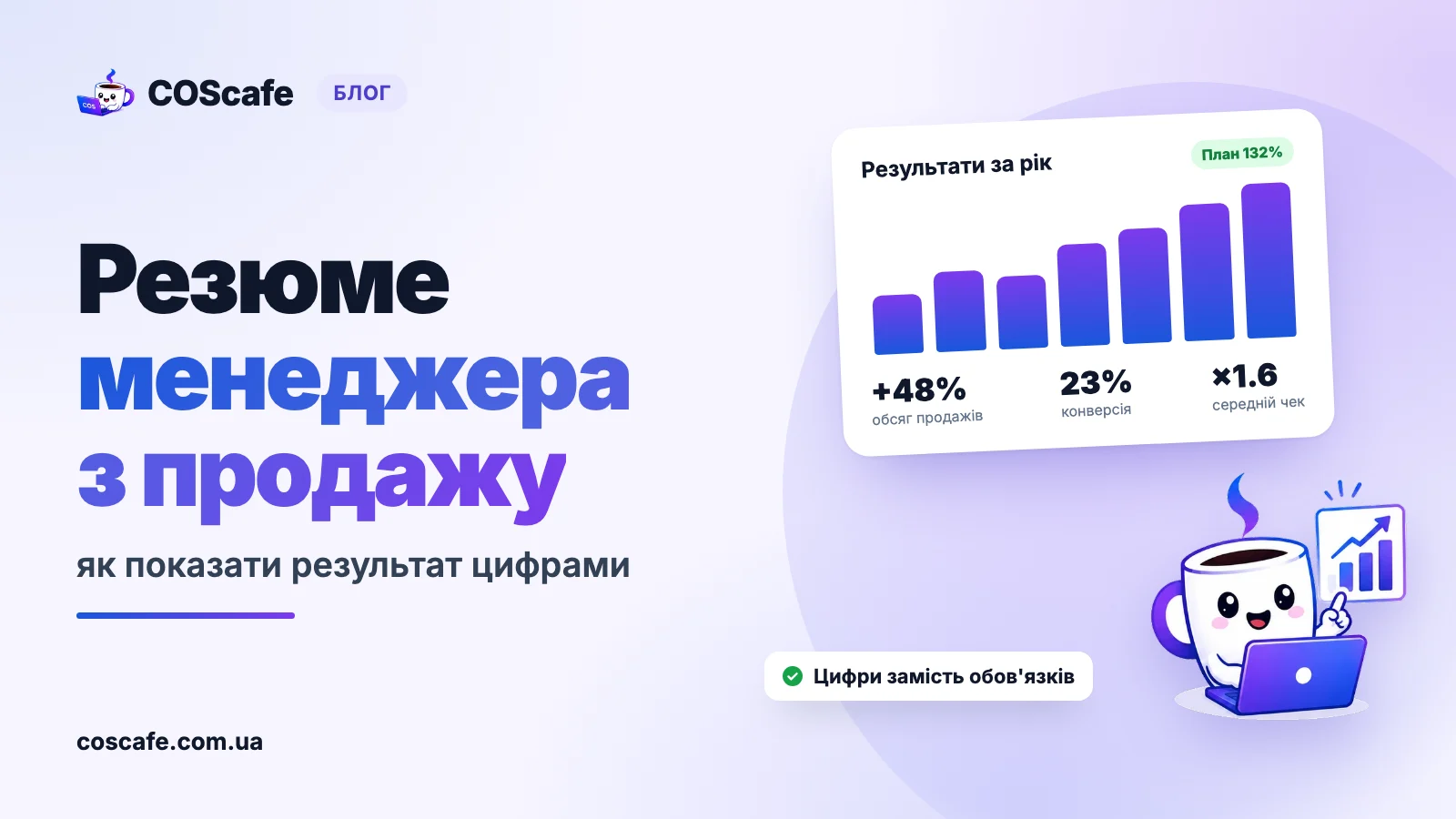
A sales manager CV works when the numbers are visible: plan attainment as a percentage, sales volume, average deal size, conversion, number of clients and deal cycle. A list of duties like "finding clients and running negotiations" gets skipped by recruiters, because everyone writes it that way. Below — what recruiters actually look for in a sales manager CV, how to rewrite your experience into an "action + result" format, and what to do when your numbers are under NDA.
What recruiters look for in a sales manager CV
Sales is one of the few professions where results are almost always measurable. That's why a sales manager is expected to show numbers more than almost anyone else. As a recruiter, I see it every day: a salesperson's CV without a single figure reads as if the person is hiding their results — even when those results were excellent.
Here are the metrics worth looking for in your own experience first:
- Plan attainment — as a percentage and over what period: "112% of plan for 2025," "beat the quarterly target 6 quarters in a row."
- Sales volume — annual or quarterly revenue, your own portfolio, your share of the team's sales.
- Average deal size — and how it changed thanks to you (upsells, bundles, moving clients to a higher tier).
- Conversion — lead to meeting, meeting to deal, trial to paid.
- Number of clients — how many you manage at once, how many new ones you brought in.
- Deal cycle — especially for B2B: cutting it from four months to two is a strong argument.
- Retention and repeat sales — the share of clients who renewed, the volume of upsells to existing clients.
- CRM experience — which system you know and what you did in it: ran the pipeline, set up stages, built reports.
Headline and summary: who you are in 5 seconds
Under your name — not just "Sales Manager," but a role with context: type of sales, market and level. For example: "B2B Sales Manager, 5 years selling SaaS to small businesses" or "Sales Manager, building materials, B2B, wholesale clients." That way the recruiter instantly knows whether you come from their world.
Summary — 2–3 sentences: what you sell, to whom, with what cycle and your single strongest result. Skip "goal-oriented, communicative, stress-resistant" — those words don't set you apart from a hundred other candidates.
- Communicative sales manager with extensive experience, good at finding an approach to clients.
- B2B Sales Manager, 5 years selling SaaS solutions to logistics companies. I close deals with a 2–4 month cycle, hit 118% of plan in 2025 and brought in 14 new corporate clients.
How to describe your experience: action + result
Build every bullet in your experience on this formula: what you did → how you did it → what it produced in numbers. Recruiters already know the duties ("ran negotiations," "found clients") from the job title. What interests them is how you did it and how it ended.
- Prospecting for new clients and cold calling.
- Managing the client base.
- Meeting sales targets.
- Working with CRM.
- Built cold outreach for the retail segment: 40+ calls a day, conversion from call to meeting grew from 8% to 15%.
- Managed a portfolio of 60 clients, kept 90% on renewal, and upsells added +20% to the portfolio volume.
- Hit 124% of the annual plan — first place among 12 managers in the team.
- Moved the team from spreadsheets to a CRM: set up pipeline stages and weekly reports, cutting the deal cycle from 45 to 30 days.
The numbers in this example are made up — your CV should contain only your real ones. A fabricated figure falls apart at the recruiter's first question, "and how did you calculate that?"
B2B vs B2C: what to highlight
Selling to businesses and selling to people are different professions, even if they share a name. If you have experience in both, set the emphasis to fit the specific role.
-
B2B
Deal size, long cycle, number of decision-makers, tenders, key accounts (without names if they're confidential — "a chain of 40 stores"). For B2B sales in IT, add the sales model: SaaS, subscription, outsourcing contracts.
-
B2C
Number of deals per day or month, conversion, average deal size, upsells, customer ratings. Here speed and volume matter more than the complexity of a single deal.
-
Common to both
Plan attainment, your place in the team, and CRM. Every recruiter reads this, regardless of the market.
If you're aiming at selling IT products, also check out our breakdown of an IT CV structure that passes ATS — it covers the order of sections and keywords from the job posting.
Skills: not a bare list of soft skills
The skills section of a salesperson's CV often looks like "communication, negotiation, stress resistance, teamwork." Such a list proves nothing. It's better to split skills into two parts.
- Tools — on a separate line, by name, as in the job posting: the specific CRM systems you know, spreadsheets, tools for outreach and calling. These are exactly the words the ATS searches for.
- Professional skills — negotiation, cold calling, handling objections, product presentation, managing key accounts. But back each of them with a bullet in your experience that shows a result.
What to do if your numbers are under NDA or don't exist
Sometimes the company forbids disclosing revenue, or you simply never tracked your own metrics. That's no reason to write a CV with no results — there are a few honest ways around it.
- Relative figures instead of absolute ones. Not "sold UAH 3M," but "grew sales in the region by 40% over the year." Percentages don't reveal trade secrets.
- Your place in the team. "Top 3 of 15 managers on plan attainment over the year" — clear without any amount.
- Awards and recognition. "Manager of the Quarter," bonuses for exceeding targets, being assigned key accounts, a promotion.
- Orders of magnitude. "Deals ranging from mid-size to large corporate level," "a portfolio of 50+ clients."
- Recover the numbers. CRM reports, emails summarizing plan results, a chat with your former manager — often the numbers exist, you just never wrote them down.
Common mistakes in a sales manager CV
- Duties instead of results. "Responsible for sales" is a job description, not your achievements.
- Numbers without context. "Sold 2M" — over what period, against what plan, alone or with a team? Without context the figure means nothing.
- The same text for every role. A hunter and an account manager are different roles, and the CV should reflect that.
- It's not clear what exactly you sell. Recruiters need to know whether it's a product, a service, a subscription, or a complex solution with a long cycle.
- Three pages of experience. Cut old jobs unrelated to sales down to a single line.
How COScafe helps with a sales CV
The hardest part of a salesperson's CV is pulling your numbers out of memory and nailing your positioning: who you are in the market and where your strength lies. For that, the COScafe resume builder has a dedicated set of positioning questions for non-IT professions, not just for developers and QA. You upload your old CV, answer the questions, optionally add a job description — and get a .docx in Ukrainian or English. Achievements and numbers aren't invented: only what's in your answers and your old CV.
And to understand what's falling short right now, first check your CV for free: a 0–100 score across three categories and a list of what to fix first. If you're job hunting not only through applications but also through direct contact with recruiters, our breakdown of finding a job through LinkedIn will come in handy — for a salesperson it's also a demonstration of self-presentation skills.
Checklist before you send your CV
- Under your name — a role with context: type of sales, market, experience.
- A 2–3 sentence summary with one strongest result.
- For each job — 2–3 numbers: plan, volume, conversion, clients, deal cycle.
- Every experience bullet is action + method + result, not a duty.
- Emphasis set for B2B or B2C to match the role.
- CRM and other tools — on a separate line, by the names from the job posting.
- Soft skills backed by results in your experience, not a bare list.
- Numbers under NDA replaced with percentages, your place in the team, or awards.
- All numbers are real, and you can explain how they were calculated.