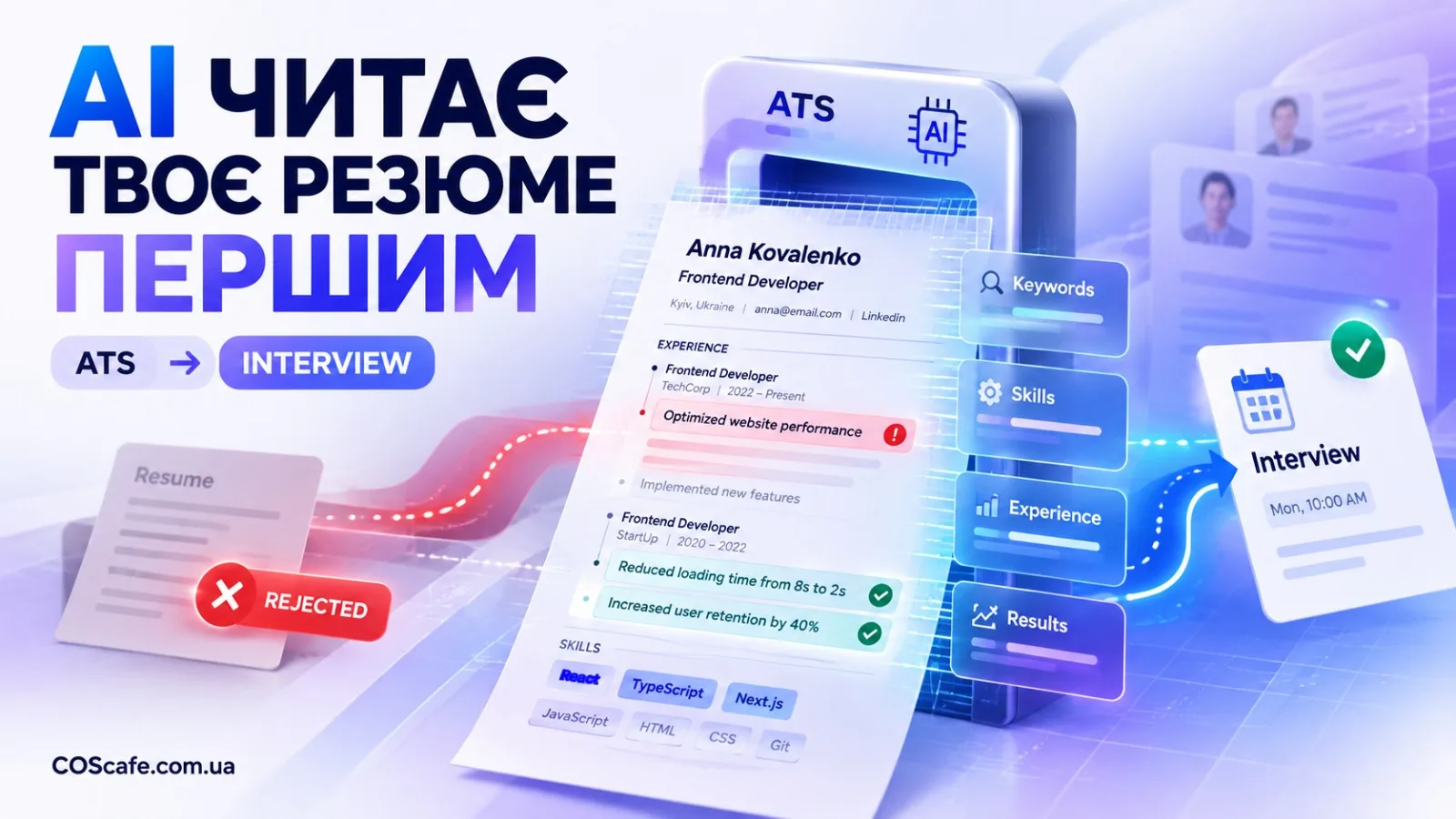
AI reads your CV before a human does. What exactly it's looking for, why a CV without a single result metric gets rejected, and what the full path to an interview looks like — all on the recording of our live session.
The difference between a CV that gets "Thank you, but we've decided to move forward with another candidate" and one that lands you straight on the interview calendar rarely comes down to design. It comes down to structure — and whether there's even a single proven result metric in the text. In 2026, that same structure is first scanned by an AI filter (ATS), and only then by a human.
Why AI now reads your CV first
If those skills aren't in your CV in the exact same words, you simply don't show up in the search.
So your structure works for you or against you before a human even glances at it: the ATS looks for keywords and a clear timeline of dates and roles, and discards anything "vague." And the recruiter who reviews what made it through the filter spends seconds on each CV, not minutes.
Checklist: 6 things both AI and recruiters look for
- A headline with level and stack — not just "Developer," but "Middle React Developer, 3+ years, TypeScript/Next.js" right under your name.
- Keywords from the job posting — if the description says "CI/CD" and you wrote "setting up deployment processes," the ATS won't read that as a match. Use the language of the job posting.
- Experience with a result metric — not "responsible for optimization," but "reduced load time from 8 to 2 seconds."
- A timeline with no mysterious gaps — it's better to briefly explain a career break in one line than to leave it blank and make the recruiter guess.
- Skills laid out clearly — in a dedicated section, not scattered across project descriptions that the ATS and the recruiter rarely read in full.
- A short cover letter for the specific role — 3–4 sentences on why this role and why you, not a one-size-fits-all template for every application.
An IT CV structure example that ATS can read
This isn't a ready-made developer CV to copy, but the order of the sections in which the AI filter and the recruiter expect to find information. This is exactly the framework that passes the first, machine-driven look:
-
Headline
Name → Middle React Developer, 3+ years, TypeScript / Next.js → city, work format, contacts
-
Short summary — 2–3 lines
Who you are, what you're strong at, and your key result — in the language of the job posting, not in generic phrases.
-
Experience — most recent first, each bullet = action + number
Company, role, dates → "reduced load time from 8 to 2 sec," not "responsible for optimization."
-
Skills — in a dedicated section
Keywords from the job posting (CI/CD, Docker, REST) where the ATS is sure to pick them up.
-
Education and certifications — briefly, at the end
No unnecessary details that pull attention away from your experience.
This is a framework, not a template to copy: the content is unique to each job posting — and that's exactly what decides whether the CV passes the filter or not.
No response — and no idea what's wrong
The hardest part of a job search isn't even rejection — it's the silence. Your application status never changes, no one explains what went wrong, and next time you tweak something in your CV at random and hope. That's not a job search anymore, it's a lottery.
Most often the problem isn't you or your experience. The CV is simply written "for yourself," not for the few seconds a recruiter spends on the first look: it lists responsibilities instead of results. That's fixable — once you can see exactly what's falling short.
"In action we trust" — a saying often quoted in career communities. The best CV isn't the one that sounds nice, but the one that describes an action and its result.
What CareerBooster participants say
This course isn't just about how to look for or land a new job — it's about how to build a career... Thank you for the well-structured way you present the material, for the gentle nudging, and for a holistic approach not just to the job search but to how you relate to your own career. Thank you for the clear step-by-step process for the CV and LinkedIn, and for the touch of humor in the interview lecture.
A few years ago you could find a job without much effort, but the market has changed. Today you need a comprehensive, structured approach and a clear strategy — CV, job search, applications, interviews. Don't count on luck; it's better to be confident and prepared.
Where to go next
This CV breakdown is part of a series we went through in the live CareerBooster sessions in September: Positioning → CV and Cover Letter → LinkedIn → 9 job search strategies → Interview. The live September cohort has already wrapped up — the recordings of all 5 workshops, along with the templates, remain available in CareerBooster.
Get access to the CareerBooster recordings (on the Quarter and Lifetime plans) →
☕ COScafe: check your CV for free
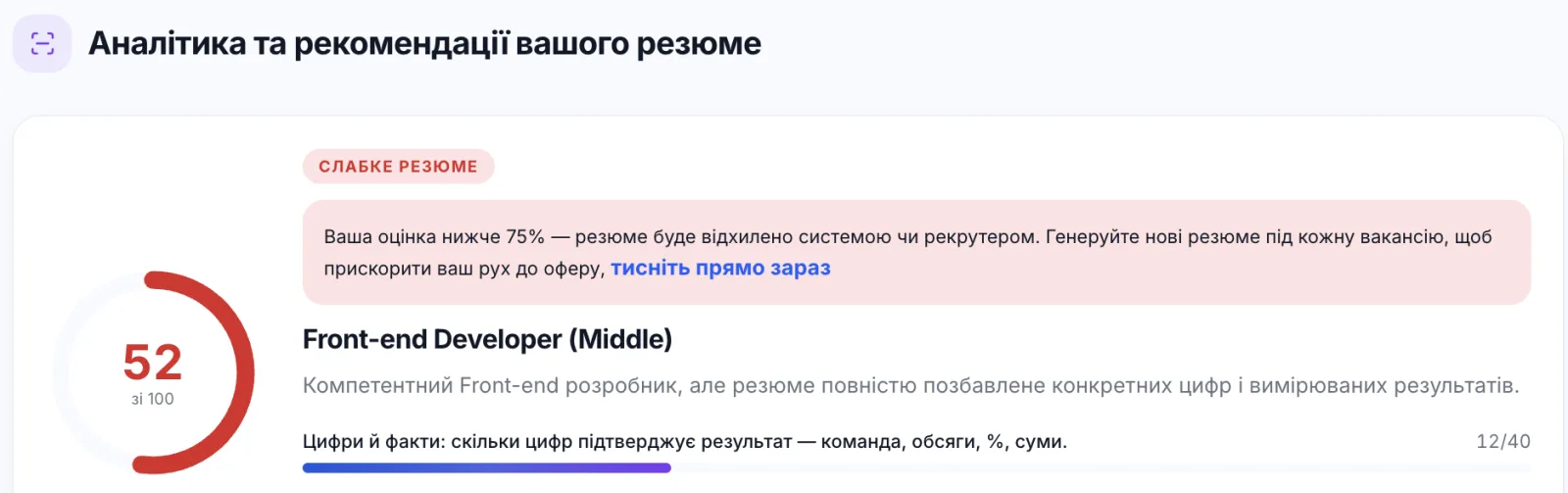
Here's what COScafe's analytics look like: a Front-end Developer (Middle) CV without a single result metric scores 52 out of 100 and gets a "Weak CV" label. The system shows exactly what's falling short — so you fix specific things instead of guessing.
CV analysis in COScafe is free.Check your CV →
Community on Telegram: t.me/+gVJntqWP3tdmMWFi
🎙️ New podcast episode
Episode #7 is out — "Hard skills are cheap with AI: what product managers are valued for now" with Vlad Halytskyi, Growth Product/Marketing Manager.
💬 Weekly Q&A session for COScafe users
Every Wednesday at 19:00 — a live Q&A session for COScafe platform users. Come with your questions about CVs, job search and interviews and get answers live.

👉 Be sure to set a calendar reminder so you don't miss it — and come with your questions.
📅 Next week
A new digest with the latest job market news and career tips — keep an eye on the newsletter.
Frequently asked questions
How many pages should an IT CV be?
One page for up to 5 years of experience, and two at most for seniors and leads with a long project history. A recruiter spends seconds on a CV, so every extra line without a result metric is a line that pulls attention away from what really matters.
Do I need a cover letter if IT roles rarely ask for one?
Yes, even a short one. Three or four sentences on why this role and why you increase the odds that your CV even gets opened — especially when hundreds of candidates apply and the recruiter is looking for a reason to single someone out of the pile.
Can I write my CV in English if I'm looking for a job in Ukraine?
It depends on the company: outsourcing and product companies with foreign clients almost always expect an English version, while local Ukrainian companies more often want Ukrainian or both. The safest bet is to have both versions ready.
Can I trust AI CV-writing tools?
A regular AI system can't produce a strong CV — it simply wasn't trained to. So it writes to a template: generic phrases, the same structure, no results at all. A recruiter spots CVs like these from the first line, and they're exactly the ones that most often get "Thank you, but we've decided to move forward with another candidate." The COScafe system was trained by a recruiter with 7 years of experience in IT hiring on hundreds of real CVs. Don't risk your own career on an AI template — build your CV with COScafe now and get ahead of the other candidates.