
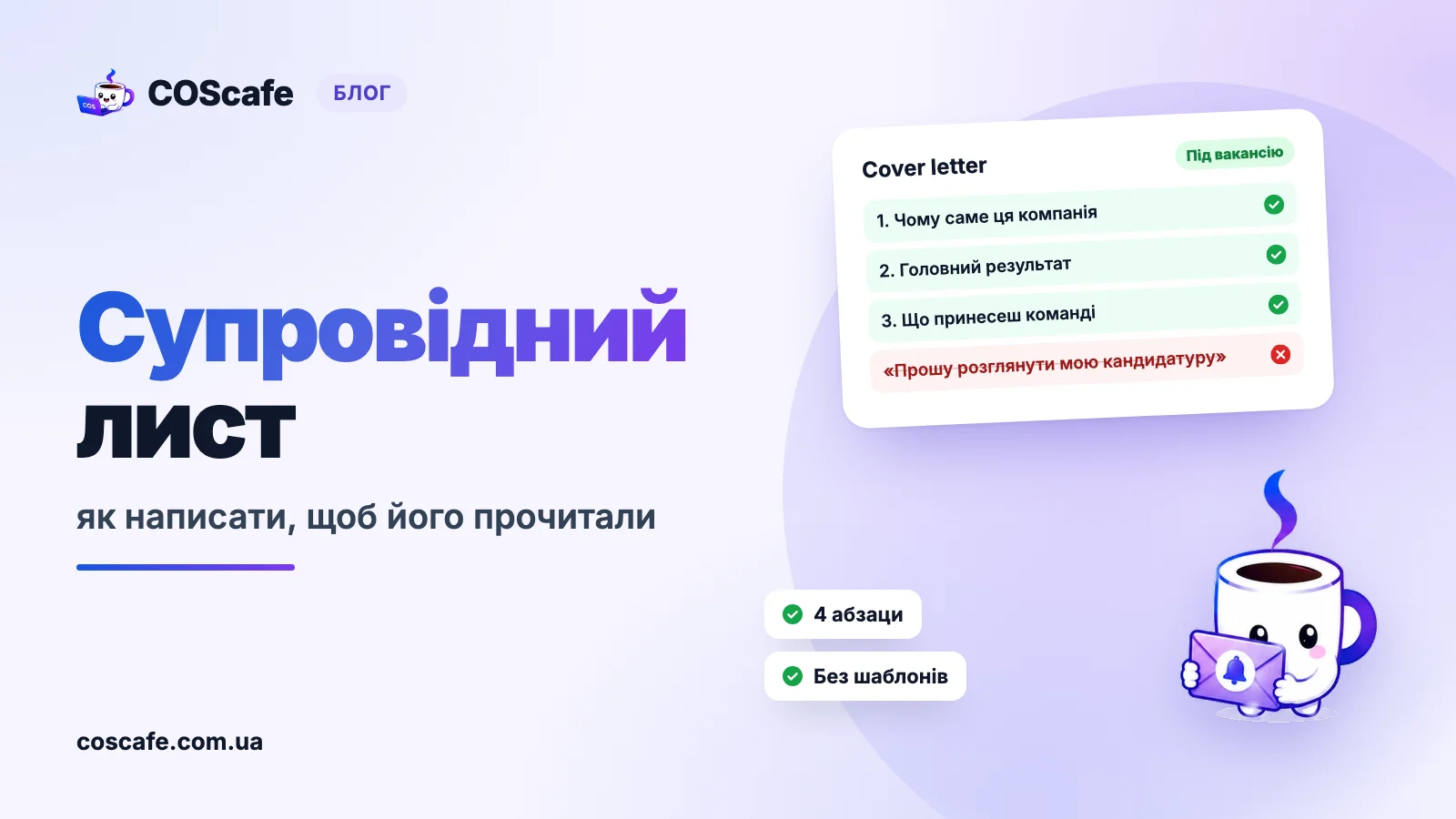
A cover letter is 4 short paragraphs written for a specific job: why this particular role interests you, how your experience matches its key requirements, one result with a number, and an invitation to talk. It doesn't repeat your CV — it explains why you're the right fit for this specific company. Below you'll find the structure, a cover letter example, and the mistakes that get a letter closed after the first line.
When a cover letter is actually needed
The honest answer: not always. Many recruiters only open a cover letter once the CV has caught their eye and they want to understand the candidate's motivation. But there are situations where the letter decides whether you even make it to a conversation:
- The job posting explicitly asks for a cover letter or motivation letter. If it's missing, that's the first sign the candidate isn't reading carefully.
- You're switching fields or roles. Your CV shows your past, while the letter explains why your experience carries over into the new role.
- Your CV has a gap, a relocation or an odd turn that's better explained in one sentence than left to guesswork.
- A small company or startup, where the CV is read by the founder or team lead, not out of a stream of hundreds of applications.
- You're reaching out directly — to a recruiter or hiring manager on LinkedIn or by email. In that case the letter is your first impression.
If the letter field is optional and you're applying for a standard role, 3–4 sentences are enough. An empty field adds nothing, but a short, precise letter is one more reason to open your CV.
Cover letter structure: 4 paragraphs
A good cover letter fits on half a page and takes a minute to read. Here's a framework that works both in IT and beyond:
-
1. The hook: why this role
Name the position and the company. In one or two sentences, say what caught your interest: the product, the challenge, the market. Not "I've always dreamed of working at your company," but something concrete from the job description.
-
2. The match: 2–3 key requirements
Take two or three requirements from the posting that matter most and show where you've already done this — in the language of the posting, using the same words.
-
3. The proof: one result with a number
One story: what the problem was, what you did, what changed. A number makes the story real: time, money, number of clients, error rate.
-
4. The close: what's next
Briefly — why you'd like to talk, and your readiness for the next step. No begging and no "hoping to hear from you" three times over.
How to tie the letter to a specific job
A generic letter is obvious right away: it fits any company, which means it fits none. As a recruiter, I can tell from the very first sentence — if you could swap in another company name and nothing would change, the letter isn't personalized.
To avoid this, read the posting with a pen in hand and take three steps:
- Write down the 3 requirements that repeat or come first. Those are what matters most to the hiring manager; the rest is "nice to have."
- For each one, find a fact from your experience: a project, a task, a number. No fact — don't mention that requirement; reinforce the others instead.
- Find one detail about the company — the product, the market, a piece of news, a team challenge from the description. One precise sentence about them beats a paragraph of compliments.
Keywords from the posting work the same way in a letter as they do in a CV: if the description says "stakeholder management," don't write "communicated with different departments." How to tailor the CV itself to a job is covered in the article "CV for IT in 2026: an example of a structure that passes ATS."
Cover letter: an example
Imagine a candidate, Maryna, applying for a Customer Success Manager role at a SaaS company that sells a booking service for beauty salons. The posting has three key requirements: experience with B2B clients, reducing churn, and onboarding new clients.
Hi there!
I'm applying for the Customer Success Manager position. What caught my attention is that your team is responsible not just for support but for retaining clients in their first three months — which is exactly what I've been doing for the past two years.
Right now I work with 60 B2B clients at a delivery service: I run onboarding, hold monthly calls with business owners, and track who's starting to drop off the product. Your clients are small businesses, and so are mine: owners who don't have time to read instructions.
Last year I noticed that most drop-offs happened in the first month, so I suggested replacing the long manual with three short training calls. Within six months, first-month churn dropped from 18 to 9 percent, and the team adopted this format as the standard.
I'd like to do the same for your clients — happy to go into more detail on a call.
Maryna
Notice there's not a single "I'm a great communicator and work well under pressure." Every sentence either shows a match to a requirement or backs it up with a fact. And the letter ends with a concrete step, not a plea.
Generic vs. strong: before → after
Most letters fail not because of grammar but because of generic phrases. Here's how the same ideas sound weak versus strong:
- My name is Oleh, and I would like to put forward my candidacy for the vacant position.
- I am responsible, goal-oriented and a fast learner.
- I have extensive experience working with clients.
- I would be grateful for the opportunity to interview.
- I'm applying for the Sales Manager role — I really like your partner-based sales model, because that's exactly how I built my pipeline over the past two years.
- In a year I learned the logistics market, which was new to me, and closed my first deal 4 months after starting.
- I manage 40 active clients, 12 of whom expanded their contracts over the past year.
- Happy to show how I built the partner channel — when would be a good time to talk?
Mistakes that stop a cover letter from being read
- Retelling your CV. The letter shouldn't duplicate your list of jobs — the recruiter has already seen it. The letter explains "why," the CV shows "what."
- "Dear Sir or Madam" and bureaucratic jargon. Address the person by name if you know it from the posting or LinkedIn. If you don't, a simple "Hi there" works.
- A mistake in the company name or position. Especially when the letter is copied from a previous application. It's the fastest way to get rejected.
- Talking about yourself instead of their problem. "I want to grow" matters to you. The company cares about what problem you'll solve for them.
- Apologies and uncertainty. "Even though I don't have experience in…" — you're spotlighting your weak point yourself. Better to show what carries over from your experience.
- A letter longer than a page. Even a strong text that runs three screens won't be read to the end.
What language to write in and how to format it
Write the letter in the same language as the posting. If the posting is in English, write in English, even if the company is Ukrainian — it's part of the test. The structure stays the same, but write in English from the start rather than translating a Ukrainian letter word for word: stiff phrasing like "I am writing to propose my candidature" sounds artificial.
- If the application form has a field — paste the text there, no attachments.
- If you're writing by email — put the letter in the body of the message and attach the CV. Subject line: position + name.
- If a file is required — use the same format as your CV (.docx or PDF), with a filename that includes your name and the position.
- In a LinkedIn message, trim it down to 3–4 sentences: a hook, one fact, an invitation to talk.
If writing a letter from scratch for every job takes too long, COScafe has a cover letter generator: it builds the letter from your CV, your answers to positioning questions, and the job description, and separately shows what you could add to make the letter stronger. The results aren't invented — only what's actually in your materials. And the CV the letter goes with can be checked for free through a recruiter's eyes before you apply.
Summary: a pre-send checklist
- The letter is written for a specific job: it names the company and the position, and you couldn't simply swap them for others.
- The 2–3 key requirements from the posting are covered — in its own words.
- There's one result with a number, not a list of qualities.
- 150–250 words, 4 paragraphs, with no retelling of the CV.
- The letter's language matches the posting's, and the company name is spelled correctly.
- The last sentence is an invitation to talk, not a request.