
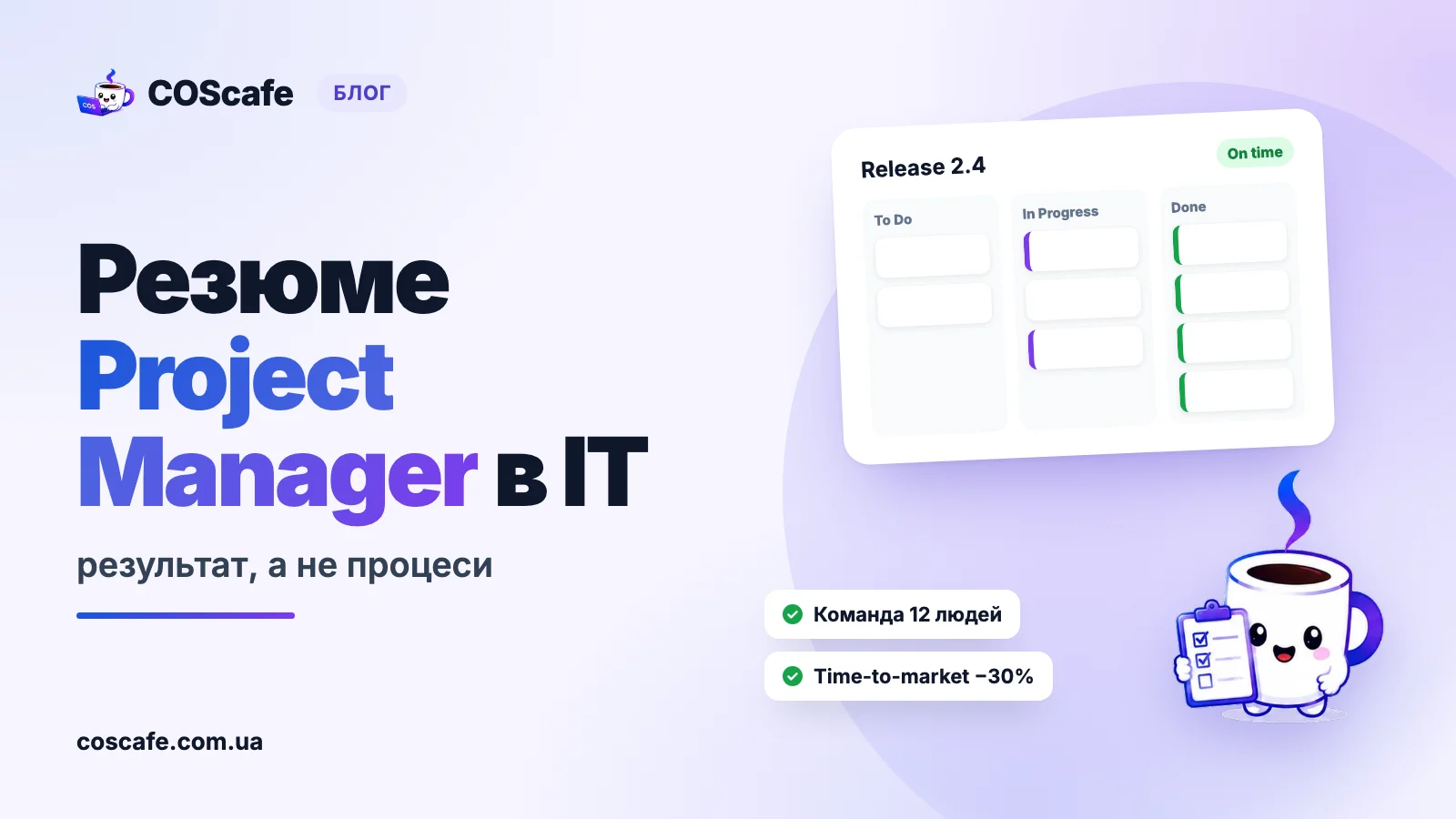
A Project Manager CV in IT needs to show scale and results: what team and budget you ran, in which domain, and what the business got out of it — an on-time release, a shorter time-to-market, a client who renewed the contract. Processes like "ran dailies, kept Jira updated" are on every PM's CV, so they do nothing to set you apart from other candidates. Below is how to rewrite your experience so a recruiter actually sees results.
We covered the basic structure of an IT CV and how ATS scans it in a separate article — "IT CV in 2026: a structure example that passes ATS". Here we'll focus on what's specific to project managers.
Why PM CVs so often sound the same
As a recruiter, I see it all the time: a dozen project manager CVs in a row, and every one says "organizing the team's work, communicating with the client, tracking deadlines, running Scrum ceremonies." It's true, but it describes the job, not your work. Recruiters and hiring managers are looking for answers to different questions in a PM CV:
- Scale. How many people on the team, how many projects in parallel, what budget, a distributed or local team.
- Context. Product company or outsourcing, type of clients, domain — fintech, healthcare, e-commerce, edtech.
- Results. What changed for the business or the client: timelines, money, quality, retention.
- Complexity. Projects that were on fire, hard deadlines, scope changes, stakeholder conflicts — and how you sorted them out.
PM, Delivery Manager or Product Manager: don't mix up the roles
These three roles often get blended together in a CV, which keeps it out of the right searches. The difference, in short:
- Project Manager is responsible for getting a specific project delivered on time, within budget and scope. The focus is planning, risks, the team, communication.
- Delivery Manager — more common in outsourcing: responsible for delivering several projects or an account, team health, margins, and the client relationship at the contract level.
- Product Manager decides what to build and why: user research, priorities, product metrics. The PM decides how and when it gets done.
Headline and summary
Under your name — the role, level and something that gives immediate context: domain, methodology or scale.
- IT Project Manager | Scrum, Kanban | Fintech, 3+ years
- Senior Project Manager | Distributed teams up to 25 | Outsourcing, Healthcare
- Delivery Manager | 4 projects, 40+ engineers | Fixed price & T&M
Summary — 2–3 sentences: experience, domain, type of projects and one result you're proud of. For example: "Project Manager with 5 years in outsourcing, delivering projects for US and EU clients in healthcare. Ran up to 3 projects at once with teams of up to 15 people. Brought a troubled project that was two months behind back on schedule and retained the client, who renewed the contract for another year."
Drop words like "communicative, stress-resistant, leader." On a PM CV, leadership isn't proven by an adjective — it's proven by what the team under you delivered.
How to describe your experience: results instead of processes
The formula is the same as for any IT role: action + result + number. In project management the numbers almost always exist — you just need to dig them out of your memory and your reports:
- team size and makeup (developers, QA, design, DevOps), number of projects at once;
- the project or account budget and whether you kept within it;
- deadlines: how many releases were on time, how much the cycle shortened;
- time-to-market — how many weeks from idea to release before and after your changes;
- client retention: renewed contract, team expansion, upsell;
- process changes with outcomes: fewer blockers, less rework, more predictable team velocity.
If the budget is under NDA — give a range or a relative figure ("within budget, no overruns," "cut infrastructure costs by about a quarter"). Don't make things up: in a PM interview you'll always be asked to tell the story behind each number.
- Project management, organizing Scrum processes, communicating with the client.
- Tracking deadlines and managing tasks in Jira.
- Working with project risks.
- Preparing reports for management.
- Led development of a mobile app for a fintech client (team of 12, budget around $400K); launched the MVP in 5 months instead of the planned 6.
- Reworked the sprint planning process in Jira together with the team: the share of tasks carried over to the next sprint dropped by about half, and 10 releases in a row shipped on time.
- Brought a troubled outsourcing project that was 2 months behind back on schedule within a quarter by re-planning the scope with the client; the client renewed for a year and expanded the team from 6 to 10 people.
- Introduced a weekly Confluence report on status, risks and budget across 3 projects at a product company — stakeholder escalations dropped from several a week to just the occasional one.
Every "after" version has scale (team, budget, number of projects), your decision, and the business outcome. Scrum and Jira haven't gone anywhere — they've just become the tool rather than the point of the bullet.
Methodologies and tools: what to put in skills
The PM skills section is the set of keywords ATS and recruiters search for. Word it the way job ads do, and group it:
- Methodologies: Scrum, Kanban, Waterfall, hybrid, SAFe (if you've actually worked with it)
- Project management: planning, risk management, scope management, budgeting, resource planning, stakeholder management
- Tools: Jira, Confluence, MS Project, Miro, Trello, Google Workspace
- Technical context: SDLC, understanding of REST API, CI/CD at the process level, basic SQL for reporting
- Engagement models: Fixed price, Time & Material, dedicated team
Common mistakes in a project manager CV
- Processes instead of results. Dailies, retros, planning — that's a working rhythm, not an achievement.
- No scale. "Managed a team" — how big? 3 people and 30 people are different roles and different pay.
- "We" instead of "I." The team shipped the release, but what exactly did you do to make it go out on time?
- Mixed roles. Half the bullets are about product hypotheses, half about deadlines, and the headline just says "Manager."
- Three pages. A PM who can't present their experience concisely raises questions about how they present a status to a client.
Moving into PM: from QA, development, or outside IT entirely
People most often move into project management from within IT: from QA, business analysis, development, account management. But experience outside IT — event management, operations, running a team in retail or logistics — is the same planning, risks and people.
-
Find the PM tasks in your experience
Coordinating a release as a QA Lead, onboarding newcomers, planning the team's work, talking to the client — that's already project experience. Bring it to the front.
-
Name the target role in your headline
Junior Project Manager / Project Coordinator — not your previous job title. The recruiter should immediately understand what you're applying for.
-
Describe transferable results in numbers
"Organized the launch of 4 branches in a year, within budget" reads as project experience even if it wasn't in IT.
-
Close the technical gap
Briefly show an understanding of SDLC, Jira, Scrum — a course, a certificate, or real involvement in an IT project.
For a PM, LinkedIn matters especially: recruiters look for project managers right there, and your profile should say the same thing as your CV. How to set it up — in the article "LinkedIn profile for an IT specialist: what a recruiter sees in a few seconds".
Want to see how a recruiter sees your current CV? Check it for free with COScafe: a 0–100 score across three categories and what to fix first. And the resume builder will help you rewrite your experience for a specific PM role based on your answers to positioning questions — with no made-up budgets or dates.
Project Manager CV checklist
- Headline with role, level and context: domain, methodology or scale.
- Summary with the type of projects and one business result.
- Every job has scale: team, budget, number of projects.
- Experience bullets are results (timelines, money, client), not a list of ceremonies.
- One role: Project, Delivery or Product — and the CV is built around it.
- Methodologies and tools in a separate section, using the words from the job ad.