
An AI resume works when artificial intelligence shapes your facts rather than inventing them for you. AI is great at helping with structure, phrasing, tailoring to a job and translation. But if you ask it to "generate a resume" from scratch, you'll get polished text that looks like hundreds of others — and a recruiter will spot it from the very first line.
Why AI-Generated Resumes Are Recognizable at a Glance
A generic AI generator doesn't know you. It knows what the average resume looks like, and that "average" is exactly what it produces: responsible, communicative, results-oriented, with experience working in a dynamic environment. These words are true of anyone, which means they tell nobody anything about you.
As a recruiter, I see it every day: ten resumes in a row with the same sentence rhythm, the same verbs at the start of each bullet, and not a single number. They're impossible to read because there's nothing to grab onto. The problem isn't that AI wrote the text — it's that there's no person in it.
Where AI Actually Helps
There are tasks AI handles faster and better than most people at 2 a.m. the night before a deadline:
- Structure. Breaking the chaotic text of an old resume into blocks: headline, short summary, experience, skills, education. Removing repetition and standardizing date formats.
- Phrasing. Turning "was involved in testing" into a bullet with an action and a result — as long as you supplied the result yourself.
- Tailoring to a job. Comparing your resume against the job description and suggesting which of your real skills to move up and what words to use so they get picked up by the ATS.
- Trimming. Condensing three pages to two without losing the substance.
- Translation. Creating an English version that sounds natural rather than a word-for-word translation from Ukrainian. More on the English resume page.
Where AI Hurts
The risks appear wherever AI lacks information. It doesn't leave a blank — it fills it in. And it fills it in convincingly.
- Invented achievements. "Increased sales by 35%" when you never actually measured it. In the interview they'll ask exactly how — and you won't have an answer.
- Template phrases. "Team player," "fast learner," "works well under pressure." They take up space that facts could have filled.
- Identical resumes. If ten candidates give an AI chat the same prompt, the recruiter gets ten nearly identical texts.
- Wrong dates and titles. Shifted years, "tweaked" job titles, technologies you never worked with but that "logically" fit the role.
- Someone else's voice. Grandiose turns of phrase you'd never say out loud. A recruiter immediately notices the gap between the paper and a real conversation.
Template Phrases: Before and After
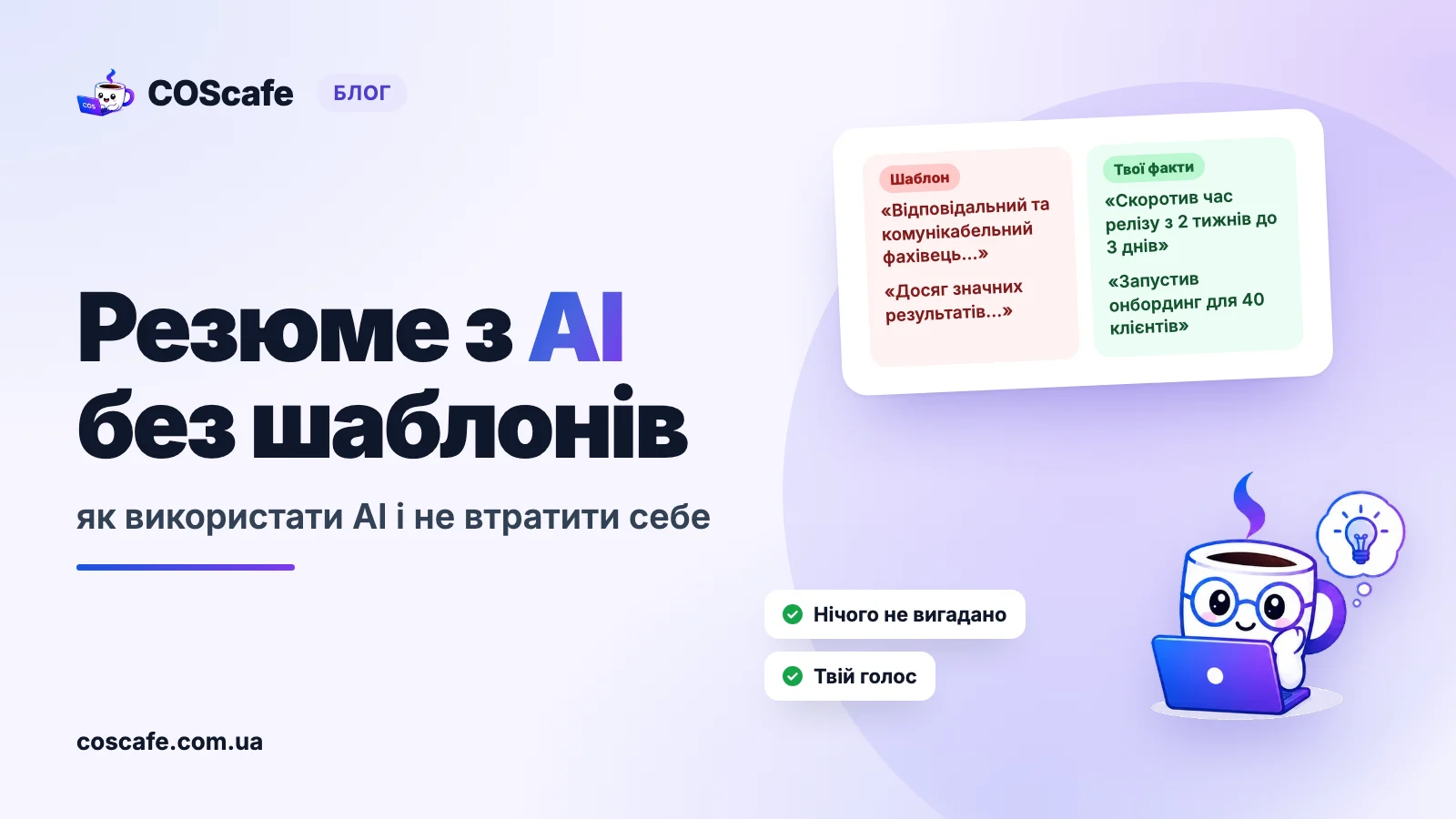
Below are the typical lines AI produces without facts, and how they look once facts are added. Notice: the "after" is impossible to write without you — only you know what you actually did and what changed.
- Responsible and driven professional with experience working in a dynamic environment
- Participated in the development and maintenance of web applications
- Collaborated effectively with the team and stakeholders
- Was involved in product testing and improving its quality
- Responsible for sales and working with clients
- Backend developer, 4 years in e-commerce: payments, supplier integrations, high load
- Rewrote the shipping cost service: response time dropped from 2 s to 300 ms
- Aligned priorities weekly with the product manager and two dev teams; release slips disappeared within a quarter
- Built a regression suite of 400 automated tests; manual regression went from 3 days to 1
- Managed 40 B2B clients, reactivated 6 "dormant" accounts in six months
The numbers in the examples are illustrative — yours will be your own. If you don't have exact figures, orders of magnitude, scale ("a team of 8," "a product across 3 countries") or a concrete outcome ("a process the whole department later used") will do.
How to Feed AI Facts Instead of Asking It to "Write a Resume"
The quality of the result isn't determined by how you word the prompt, but by what you put into it. Before opening an AI chat, gather your input data — essentially, work through your own positioning:
-
Goal
What role you're after, at what level, in what domain. "Middle QA at a product company, fintech" is a goal. "Any job in IT" is not.
-
Experience by Role
For each job, 2–4 tasks you actually handled, with scale: product, team, users, volumes.
-
Achievements with Numbers
What changed thanks to you: faster, cheaper, more, fewer errors. Write down even approximate values — and flag where they're approximate.
-
Job Description
Paste the full job description. Then AI can move up exactly the skills the employer is looking for and name them with the words from the posting.
-
Constraints
Say it outright: "Don't add any facts that aren't in my text. If data is missing, ask me." That's half the battle.
If you're in IT, it helps to check the result against the structure broken down in the article "An IT Resume in 2026: A Sample Structure That Passes the ATS" — it covers the order of the blocks and keywords.
How to Review Your Resume After AI
Don't send the finished text right away. Read it through the eyes of someone who doesn't know you — and who in a week will be sitting across from you in an interview.
- Every fact is yours: numbers, technologies, company names and job titles match reality
- Dates checked line by line: years, months, the duration of each role
- The job's keywords are in the text — but only the ones you genuinely know
- No empty phrases like "team player" or "results-oriented"
- You can expand every experience bullet into a 2–3 minute story
- The text sounds like you: read it aloud — if that's not how you talk, rewrite it
- Links (portfolio, GitHub, LinkedIn) work and lead exactly where they should
It's also worth seeing how a recruiter would perceive the resume. For that there's a free resume assessment: a score from 0 to 100 across three categories and a list of "what to fix first." It's handy to run both the old resume and the new version through it — and compare.
What to Do with an AI Resume in the Interview
A recruiter doesn't ask whether you used AI. They ask about the content. So prepare for the interview based on your own resume:
- For each achievement, prepare a short story: what the situation was, what exactly you did, what result came out of it, and how you measured it.
- Go through your skills list and honestly mark the ones you can speak about confidently. Remove or rephrase the rest.
- Reread your summary aloud. If you're asked to "tell me about yourself," your answer should match it in substance.
- If asked directly, answer directly: "AI helped with the structure and the English; the facts and numbers are mine." That's a fine answer, as long as it's true.
A good resume isn't the text a recruiter liked. It's the text you can back up with every line in the interview.
The "Positioning First, Text Second" Approach
Everything described above comes down to one order of operations: first the facts about you, then the text. That's what the COScafe resume builder is built on: you upload your old resume, answer positioning questions (a separate set for IT and for non-IT), optionally add a job description, and choose the language — Ukrainian or English. Achievements, dates and links aren't invented in the process: they're taken only from your answers and your old resume.
Whatever tool you use, the logic is the same: AI amplifies what you give it. Give it emptiness and you get a template. Give it facts and you get a resume that sounds like you, only sharper.
In Short
- Use AI for structure, phrasing, tailoring to a job and translation
- Only you provide the facts, numbers and dates — and you explicitly forbid AI from making them up
- Before sending, check every line: is it yours, are the keywords there, does it sound like your voice
- Prepare for the interview based on your resume: every bullet is a story you can tell