
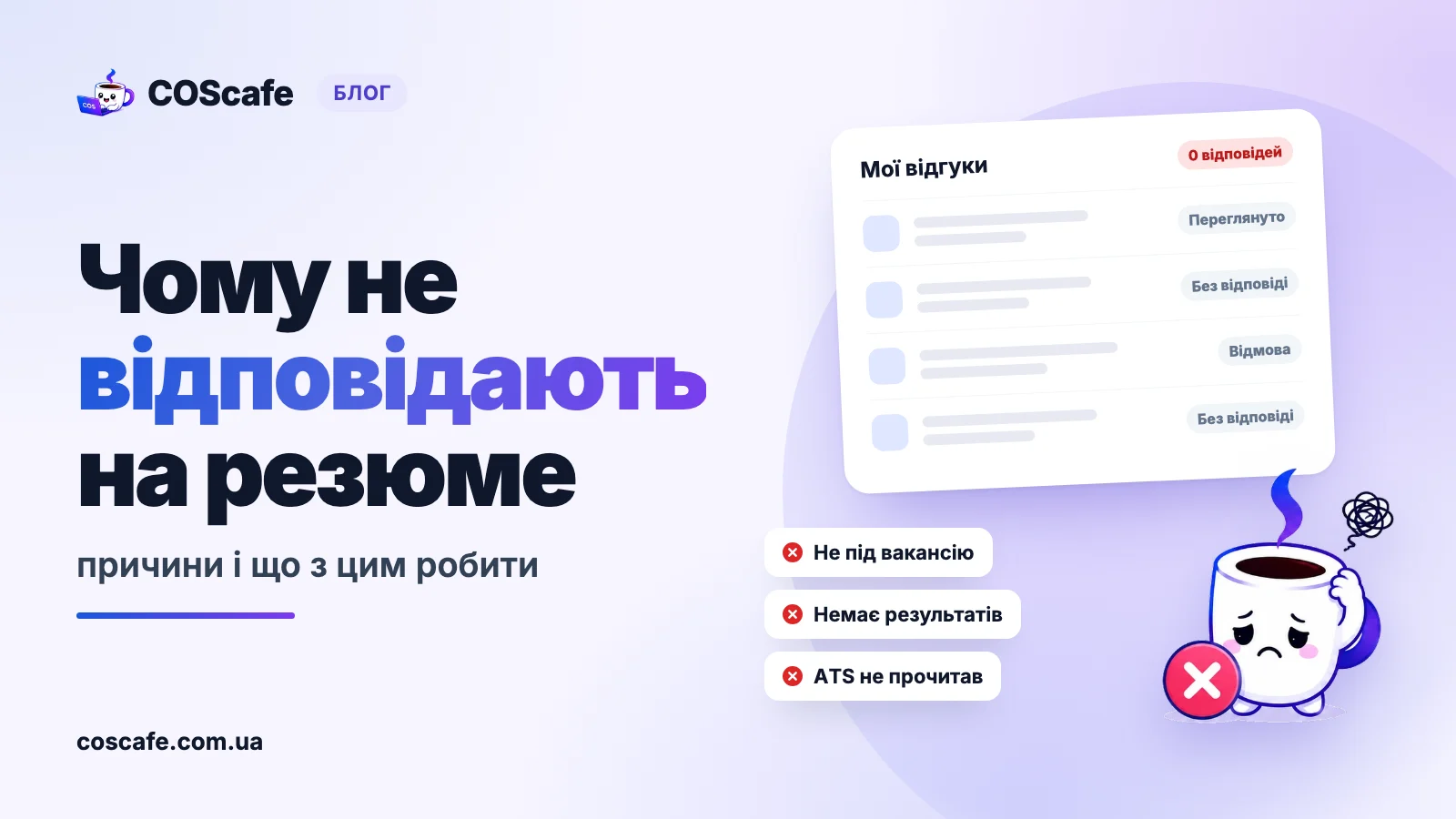
Most of the time, CVs go unanswered not because of a lack of experience, but because the recruiter doesn't see a match in the first few seconds: the CV isn't tailored to the role, it's missing the right keywords, it's in a format the ATS can't read, or it shows no results. Below are 10 reasons for the silence after you apply, how to spot each one in your own CV and what to fix — plus a one-week plan.
Why silence is a signal, not a verdict
Silence after you apply feels like a personal rejection, but more often it's simply a breakdown at one of the stages: the system didn't find the keywords, the recruiter couldn't tell which role you were going for, or your application arrived after candidates had already been shortlisted. As a recruiter, I see it all the time: strong people with solid experience get lost over things you can fix in one evening.
The good news is that you can check most of these reasons yourself. Go through the list below and honestly tick off whatever applies to you.
10 reasons employers don't respond to your CV
1. Your CV isn't tailored to the job
How to spot it: you send the same file to every job; the headline under your name doesn't match the title of the role you're applying for; the top bullets of your experience are about something else.
What to do: for every job you're interested in, adjust the headline, the summary and the order of your bullets so the most relevant points come first. That's 10–15 minutes, not a brand-new CV from scratch. We break it down step by step in our article on how to write a CV in 2026.
2. Your CV has none of the job's keywords
How to spot it: open the job post and your CV side by side. If only two or three of the 5–7 key requirements appear in your text using the same words, neither the system nor the recruiter really "sees" you.
What to do: use the job post's wording wherever it's true for your experience: if it says "project management" and you wrote "task coordination," switch to the job's language. But only for things you actually did.
3. A format the ATS can't read
How to spot it: a two-column CV with tables, icons, rating bars like "Excel — 4 out of 5 stars," contact details in the header/footer, or saved as a scanned PDF. It looks nice to a human, but the system may scramble it into mush or not read it at all.
What to do: one column, standard section headings, text without images, and a .docx or a PDF where you can select the text with your mouse. The check is simple: copy all the text from the PDF into a plain text editor — if the order is preserved and nothing disappeared, you're fine.
4. A vague headline and summary
How to spot it: under your name it says "Specialist," "Looking for a job," or lists three different professions separated by slashes. The summary reads like "responsible, great communicator, fast learner."
What to do: one specific role, as worded in job posts, and 2–3 sentences: who you are, how many years of experience, in what field, and one key result.
- Manager / administrator / operator. Great communicator, handles stress well.
- Medical center administrator, 3 years. I manage bookings for up to 8 doctors and online consultations; I set up patient reminders, which noticeably cut no-shows.
5. No results — just duties
How to spot it: almost every bullet starts with "responsible for," "handled," or "managing." After reading it, it's unclear how you differ from anyone else in the same role.
What to do: rewrite your bullets as "action + result": what you did and what it changed. A number, a scale, a before/after comparison — anything that's true will work.
6. Applying above or below your level
How to spot it: you're applying for a Senior role with two years of experience, or for an entry-level position with ten. In both cases the recruiter sees a risk: either you won't cope or you'll leave quickly.
What to do: read the requirements literally: if fewer than half of the key ones match, it's not your job right now. If you're deliberately stepping down a level (changing fields, relocating), explain it in one sentence in your summary or cover letter.
7. You applied too late
How to spot it: the job has been open for a week or two and you apply as the first response on a Sunday evening. For popular roles, recruiters often shortlist the first relevant candidates and stop looking as closely after that.
What to do: set up alerts for new jobs and apply within the first 1–2 days. For that your CV needs to be ready in advance — a base version plus a quick tailoring.
8. No cover letter where one is expected
How to spot it: the job has a message field or a request to "tell us why this role interests you," and you leave it blank or write "Hi, please find my CV attached."
What to do: 3–5 sentences: why this company and role specifically, which of your experience solves their main challenge, and one concrete result. You can put together a letter tailored to the job from your CV in the cover letter builder — it even suggests what's worth adding.
9. Your LinkedIn doesn't match your CV
How to spot it: your CV says "Project Manager" but LinkedIn still shows your old title; dates and companies don't line up; the profile is empty or has no photo. A recruiter almost always opens your profile — and any discrepancies raise questions.
What to do: check that titles, dates and companies match; set your LinkedIn headline to the same role as your CV. For exactly what a recruiter manages to see on a profile in a few seconds, read the article on the LinkedIn profile.
10. Mass applying
How to spot it: in one week you hit "quick apply" on 50+ jobs, half of which you didn't even finish reading. You get almost no replies, and you have no idea which part of your CV failed.
What to do: 10 applications with a tailored CV beat 50 identical ones. Keep a simple tracker: company, role, date, which CV version you sent, whether you included a letter. That way, within a week or two you'll see what's working.
How to figure out which reason applies to you
Look at your applications from the last 2–3 weeks and count two things: how many times you got any reply at all, and how many times you were invited to talk.
- No reaction at all — the problem is most likely the format (ATS), the keywords, or a CV that isn't tailored to the role. Start with reasons 1–3.
- Instant rejections — you were read, but they didn't see a match: level, headline, results. Reasons 4–6.
- Occasional invites, but rarely — the basics are fine, you're missing details: speed, a cover letter, an aligned LinkedIn. Reasons 7–10.
To stop guessing, you can look at your CV through a recruiter's eyes: the free assessment at COScafe gives you a score from 0 to 100 across three categories and tells you what to fix first.
What to do next: a one-week plan
-
Day 1 — diagnosis
Go through the 10 reasons above and write down the ones that apply to you. Test your CV for ATS: copy the text into a plain text editor.
-
Day 2 — format and headline
Convert your CV to a single column with no tables or images. Create a specific job-title headline and a 2–3 sentence summary.
-
Day 3 — experience
Rewrite your experience bullets using the "action + result" formula. At least two results for each of your most recent jobs.
-
Day 4 — LinkedIn
Align titles, dates and your profile headline with your CV. Update the About section for your target role.
-
Day 5 — picking jobs
Find 8–10 fresh jobs where most of the key requirements match. Set up alerts for new ones.
-
Days 6–7 — targeted applications
For each job: a tailored headline, summary and bullet order, plus a short cover letter. Log everything in your tracker.
If you don't have the energy to rewrite your CV from scratch, in the COScafe builder you can upload your old CV, answer a few positioning questions and add the job description — and get a version tailored to a specific role. Achievements and dates are taken only from your answers and your old CV; nothing is made up.
In short
- One CV for every job is the main cause of silence. Tailor the headline, summary and order of your bullets.
- Check that your CV is ATS-readable: single column, no tables or images, a text file.
- Results instead of duties, a specific role instead of generic phrases.
- Apply on time, at your own level, with a cover letter where one is expected, and with a LinkedIn that matches.
FAQ
How long should I wait for a reply to my CV?
Usually anywhere from a few days to two weeks. If it's been silent for a week and the job is still open, you can send the recruiter a short message on LinkedIn: remind them of your application and explain in one sentence why you're a good fit.
Should I apply to the same job a second time?
Only if you've significantly changed your CV and a few weeks have passed. Resending the same file won't change anything.
Why don't I get interviews even though my experience fits?
Most often the experience is there but it isn't visible: it's described as duties, not in the words used in the job post, or it's hidden in a format the system couldn't read. Start with reasons 2, 3 and 5.