

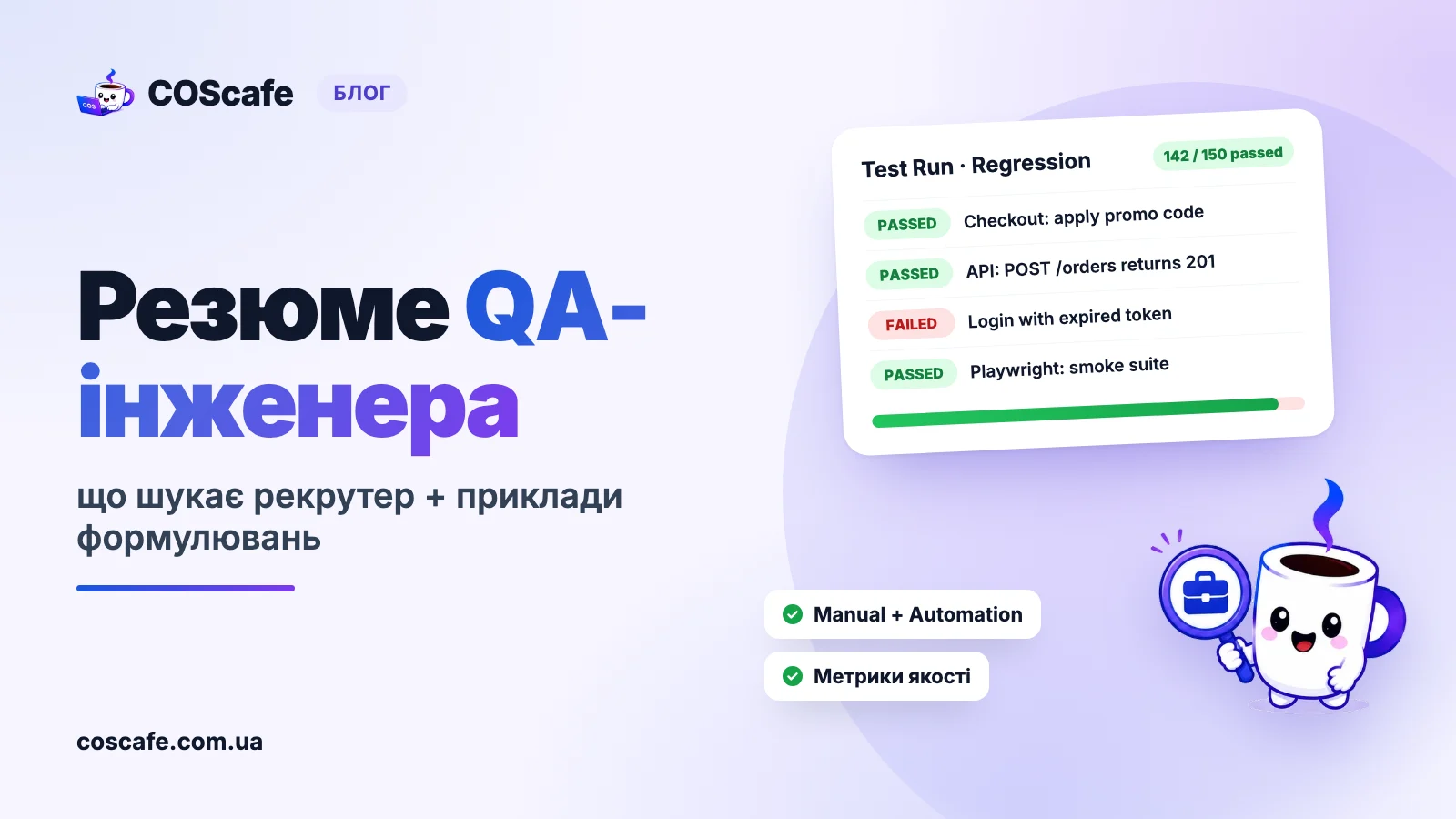
A strong QA engineer resume answers three questions within the first few seconds: Manual or Automation, which tools you work with, and how product quality improved because of you. Not "tested the functionality," but "found," "automated," "cut the regression" — with numbers. Below I break down how to write this, with "before → after" example phrasing for junior, middle and senior.
We already covered the general structure of an IT resume and how ATS reads it in the article "IT Resume in 2026: a Structure Example That Passes ATS." Here we focus only on what's specific to testers.
What recruiters look for in a QA resume
As a recruiter, I see the same problem in most testers' resumes: they describe the process, not the contribution. "Wrote test cases, ran regression testing, logged bugs in Jira" — that's a job description you could copy from any job posting. But in a few seconds, a recruiter is looking for something else:
- Type of role. Manual QA, QA Automation, Full-stack QA or QA Lead — this should be clear from the headline, not from the third paragraph.
- Types of testing. Functional, regression, smoke, API, UI, mobile, performance — the ones you actually did, not the whole textbook.
- Tools and language. For automation — the programming language and framework. Without that line, an Automation QA resume simply doesn't show up in search.
- Domain and product type. Fintech, e-commerce, healthcare, mobile app, B2B SaaS — a recruiter is looking for someone who already understands the specifics.
- Impact on quality. How many bugs never reached production, how much faster the regression became, what you introduced into the process.
Manual vs Automation: what changes in the resume
These are two different roles on the market, and a resume that's "about everything at once" reads as "neither here nor there." Decide what you're applying for and build your resume around that direction.
Manual QA — the focus is on depth: how you analyze requirements, build test documentation, test APIs via Postman, check data with SQL, work with mobile devices and browsers. The strength of Manual lies in understanding the product and business logic, and that's exactly what you should show.
QA Automation — the focus is on code and infrastructure: the language (Java, Python, JavaScript/TypeScript), the framework (Selenium, Playwright, Cypress, REST Assured), test framework architecture, CI/CD integration, test stability, run time.
Headline and summary: the 3 lines that decide everything
The headline under your name is your position, not just "QA" or "Software Tester." Add the level, type and key stack:
- Junior Manual QA Engineer | Web, API (Postman), SQL
- Middle QA Automation Engineer | TypeScript, Playwright, CI/CD
- Senior QA Engineer / QA Lead | Fintech, Java, test strategy
The summary is 2–3 sentences: who you are, in which domain, and your strongest result. For example: "QA Automation Engineer with 4 years of experience in e-commerce. Built a Playwright + TypeScript framework from scratch and cut manual regression from three days to a few hours. Looking for a product team where quality is part of the development process, not a final stage."
What you don't need in a summary: "attentive to detail, stress-resistant, fast learner." Every tester writes this, so recruiters simply skip those lines. Attention to detail is better shown through a result in your experience.
How to describe experience: action + result + number
Every experience bullet is an action that you personally took and what changed because of it. There are almost always metrics in QA — they just rarely get written down. Here's what you can count:
- the number of test cases you wrote or updated, and for how much functionality;
- automation coverage — of critical scenarios, API endpoints, the regression suite;
- regression time before and after automation or optimization;
- bugs found in production — how their number changed per quarter or release;
- the release frequency you managed to maintain thanks to stable tests in CI/CD;
- the number of people you onboarded or mentored.
If you don't remember exact figures, write an honest approximation ("about 300 test cases," "regression was cut roughly in half"). Made-up numbers are risky: in the interview, you'll be asked to explain exactly how you counted.
Here's how the same bullets look before and after:
- Testing the web app, writing test cases, logging bugs in Jira.
- Worked on test automation.
- Ran regression testing before releases.
- Tested APIs.
- Wrote and maintained 350+ test cases in TestRail for the payments module of a product e-commerce platform; critical production bugs dropped from 9 to 2 per quarter.
- Built an automated test framework in Playwright + TypeScript from scratch, covered 80% of critical scenarios, and integrated test runs into CI/CD (GitLab CI) on every merge request.
- Cut manual regression from 3 days to 4 hours by automating smoke and regression suites — the team moved from biweekly to weekly releases.
- Tested 60+ REST endpoints in Postman and wrote collections with checks for an outsourcing project team; found 15 data validation defects before frontend integration.
Notice that in every "after" there's a tool (a keyword for ATS), an action (a past-tense verb) and an outcome for the product or team. That's the exact formula that sets apart a resume that gets invited to interviews.
Emphasis for junior, middle and senior
-
Junior: show you can get hands-on
If you have little commercial experience, use pet projects, testing of open-source apps, or course projects with real documentation (test plan, checklists, bug reports). Add a link to GitHub or a sample bug report. The key is to show knowledge of testing types, Jira, Postman, basic SQL and Git.
-
Middle: show independence and impact
You're no longer just completing tasks — you test a feature from requirements to release, influence the process, and automate. Here the numbers matter most: regression reduction, coverage, release stability, bugs that never reached users.
-
Senior / Lead: show strategy and people
Test strategy for a product, tool selection, building a QA process from scratch, working with quality metrics, mentoring, team size. A recruiter isn't looking for "the best tester," but for someone who owns the quality of an entire product.
Skills and stack: keywords, not a paragraph
The skills block is how ATS and recruiters find you in search. Group them by category and write the names the way they appear in job postings:
- Testing: functional, regression, smoke, API testing, UI testing, mobile testing, exploratory testing
- Test management: Jira, TestRail, Zephyr, Confluence
- API and data: Postman, REST, Swagger, SQL (PostgreSQL, MySQL), DevTools
- Automation: Selenium, Playwright, Cypress, REST Assured, Page Object Model
- Languages: Java, Python, JavaScript, TypeScript
- CI/CD and tools: Git, GitLab CI, GitHub Actions, Jenkins, Docker, Allure
Common mistakes in a tester's resume
- A list of duties instead of results. "Testing, documentation, bug reports" — that's what every other resume looks like.
- Mistakes in the resume itself. Typos and inconsistent date formatting hit harder in a QA resume than anywhere else: after all, you're the person who finds defects.
- Mixed Manual and Automation with no explanation. The recruiter can't tell which role you're going for.
- A stack with no context. 25 tools in the skills block and not one of them in the experience.
- No domain. "Tested a web app" — which one? For whom? Fintech and a streaming service are tested very differently.
Switching to QA from another field
QA is one of the most common entry points into IT, and prior experience often works in your favor here. An accountant understands the financial logic that gets tested in fintech, a support specialist knows how users break a product, and a teacher can write clear documentation.
What to do in your resume: put the target role in the headline (Junior Manual QA), and in the summary add one line on how your prior experience helps in testing. Above your previous job, add a "Projects" block: what you tested, how many bug reports and test cases you wrote, which tools you used. Describe your previous job briefly, but with transferable skills: working with data, attention to processes, communication with clients. For the first step in your search and how not to get lost among applications, see the article "How to Look for a Job in IT in 2026: 6 Steps."
A tester gets hired for spotting a problem before the user does. Your resume is the first place where you show it.
To see how your resume reads through a recruiter's eyes, check it for free at COScafe: a score from 0 to 100 and what to fix first. And if you want to rewrite your resume for a specific QA job, the resume builder will assemble it from your answers and your old resume — with no invented numbers or achievements.
QA engineer resume checklist
- The headline includes your level, role type (Manual / Automation) and 2–3 key tools.
- A 2–3 sentence summary with your domain and one strong result.
- Every experience bullet is action + tool + result, with a number where possible.
- For Automation — the language, framework and CI/CD are named explicitly.
- Skills are grouped and match the words in the job posting.
- The resume is proofread: no typos, consistent date format.