

A resume with no work experience is built not around jobs you've held, but around proof that you can already do the job: pet projects, course projects, internships, volunteering and freelance work. You describe each of these like a job — what you did, how you did it, what came out of it. Below: what to put in place of experience, how to describe a project, an example of a junior CV structure, and the mistakes that make a student's resume look empty.
What a recruiter looks for in a resume with no experience
Nobody expects a junior to have five years at a product company. As a recruiter, I look at an entry-level resume with a different question in mind: has this person actually built something with their own hands, or just sat through lessons? A course means "I studied this." A project means "I did this." That's a huge difference.
So the job of a junior CV is to show three things:
- You know what role you want — one specific role, not "any job in IT."
- You've already applied your skills on real or close-to-real tasks.
- You learn systematically — there's a clear progression, not ten courses with one lesson each.
What to put in place of work experience
"Experience" isn't just a line in your employment record. Everything below can and should go on your resume if it's relevant to the role you're applying for:
- Pet projects — an app, website, bot, dashboard or piece of research you built yourself. For IT, this is your strongest argument.
- Course or university projects — as long as it's a full task, not a 20-minute exercise. A team project is especially valuable.
- Internships and practical placements — even short ones, even unpaid.
- Freelance and one-off gigs — a website for a friend's business, translations, design, setting up ads. A real client means real experience.
- Volunteering — running a fundraiser, managing an initiative's social media, coordinating people. That's experience in communication and taking responsibility.
- Jobs outside your field — waiter, salesperson, administrator. Keep it short, but highlight transferable skills: working with customers, speed, handling money responsibly.
If you don't have any projects yet
Build one, and see it through to the end. Pick a task your future role actually solves: for QA — test an open app and write up test cases and bug reports; for an analyst — take an open dataset and answer one business question; for a developer — build a small service that someone actually uses. One finished project with a description and a link counts for more than three abandoned halfway. And spend weeks on it, not months: the goal is to show how you work, not to build the perfect product.
How to describe a project by its result, not the process
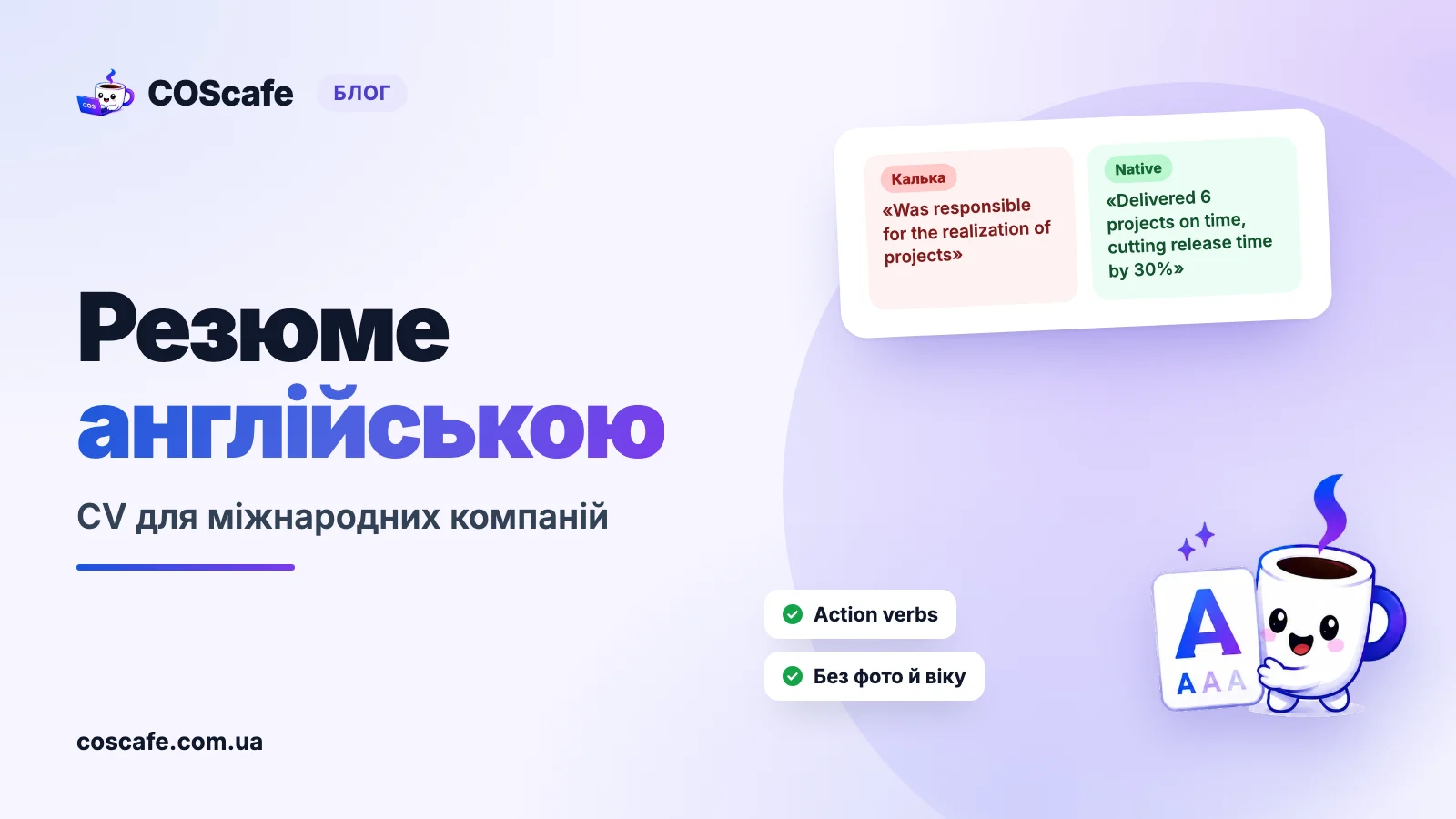
Most junior resumes describe a project like a school assignment: "built a website using HTML and CSS." A recruiter gets no sense of either the complexity or the result from that. Describe the project the way you'd describe a task at work: what the problem was, what you did, what came out of it.
- Built a to-do app in React.
- Did data analysis as part of a course.
- Handled social media for a volunteer organization.
- Took part in a team project.
- Built an expense-tracking app in React and Firebase: authentication, categories, monthly charts. 15 friends use it; code and demo at the link.
- Analyzed open rental-housing data across 5 cities (Python, pandas): found how floor area and neighborhood affect price, and pulled the findings together into a dashboard.
- Ran a volunteer initiative's Instagram for 8 months: content plan, 3 posts a week; grew followers from 400 to 2,100.
- On a team of 4, owned the backend: designed the database and a booking API, closed 30 tasks in 6 weeks.
The formula is the same as for an experienced candidate: action + tool + result. In a project, the result is users, speed, volume of data, tasks completed, client feedback. And always include a link: GitHub, a portfolio, a demo, Behance — for a junior, that speaks louder than any words.
Education and courses: how to present them so they work for you
On a resume with no experience, education sits higher than usual — but not in first place if you have strong projects. A few rules:
- University — name, major, years. GPA only if it's high. Thesis topic only if it's relevant to the role.
- Courses — relevant and completed ones only. Better 2–3 serious ones than 12 short ones: a long list reads as "I study constantly but never ship anything."
- What you actually learned — one line under the course: technologies, final project.
- Certificates — with a verification link, if there is one.
- Languages — your honest level. English matters in IT, so don't inflate it: they'll test it in the very first conversation.
Example of a junior CV structure
Here's the order of sections for a hypothetical candidate, Iryna, who's looking for her first Junior QA Engineer role after a course:
-
Header
Iryna · Junior QA Engineer (Manual) · Lviv, open to remote · email, phone, LinkedIn, GitHub.
-
Summary — 2–3 lines
Junior QA with a testing course and 2 course projects: test cases, bug reports, API testing. Previously spent 2 years as an administrator — used to being detail-oriented and working with customers.
-
Projects
2–3 projects: what you tested, with what tools, how many test cases and bugs you found, a link to the documentation.
-
Skills
Test design, bug tracking, API testing, basic SQL, Git. Only what you can actually demonstrate.
-
Education and courses
University + 1–2 relevant courses with final projects.
-
Other experience
Administrator job — one or two lines with the skills that transfer to QA.
The structure an ATS expects is broken down in detail in the article "An IT Resume in 2026: A Structure That Gets Through the ATS," and how to actually search for your first job — not just write a resume — is covered in "How to Find a Job in IT in 2026: 6 Steps."
How not to look "empty" on a single page
A junior resume often feels empty not because of a lack of experience, but because of how it's presented. What helps:
- One page — and a full one. A dense page packed with projects beats two pages of wide margins and a list of personal qualities.
- Specifics in every line. Numbers, tool names, links — they fill the space with meaning.
- A role-focused headline. "Junior Frontend Developer" instead of "4th-year student" — you're positioning yourself as a professional, not as someone who's still studying.
- A resume tailored to the job. Reorder your projects so the one closest to the requirements comes first.
- No "personal qualities" section. "Great communicator, fast learner" is what every other junior writes. Show it through a project instead.
Common mistakes in a student's resume
- A goal of "gaining experience and growing." That's your goal; what the company needs is an answer to how you're useful to them.
- Listing every technology you've ever heard of. A recruiter or team lead will ask about any one of them. Keep only what you've actually worked with.
- Projects with no links. If the code or the result can be shown — show it.
- One resume for every role — QA, analyst and support all at once. Better to have a few versions for different directions.
- A vacation photo, your age, marital status. It doesn't help and it eats up space.
Once your draft is ready, you can get it reviewed through a recruiter's eyes for free at COScafe: you'll get a score across three categories and a list of what to fix first. And if it's easier to start from questions than from a blank page, the resume builder walks you through positioning questions and assembles a resume from what you tell it — inventing nothing.
Summary
- In place of experience — projects, internships, freelance, volunteering, each described like a job.
- Every project has an action, a tool, a result and a link.
- Education and 2–3 relevant courses — kept short, with what you learned.
- A headline focused on one specific role, on one dense page.
- No made-up numbers and no list of qualities.