
An English resume for an international company isn't a translation of your Ukrainian one — it's a separate document that follows different rules: no photo, age or marital status, experience written as "action verb + result", job titles in English and dates in the "Mar 2023 – Present" format. Write it in English from the start rather than translating word for word — a literal rendering of Ukrainian shows from the very first line. Below is what to remove, how to describe your experience, and a sample block.
CV vs. resume: what's the difference
In Ukrainian both words translate as "резюме", but abroad they mean different things:
- Resume — short, 1–2 pages, only what's relevant to a specific role. This is standard in the US and Canada, and it's exactly the format most IT and product companies expect.
- CV (curriculum vitae) — in the UK and parts of Europe, this is what they call that same short document. In academia, a CV is a long list of publications, conferences and grants.
In practice: if a job in business or IT asks for a "CV", they expect a regular 1–2 page resume. A long academic CV is only needed for research and teaching.
What to remove from a Ukrainian resume
Things that are sometimes still considered normal in Ukraine are, in international hiring, unnecessary or even risky. In many countries, recruiters aren't allowed to factor in age, marital status or appearance, so resumes with such details may simply be set aside to avoid any risk.
- Photo — don't include one for the US, Canada or the UK. If you really want one, it's on your LinkedIn.
- Date of birth and age.
- Marital status, children, citizenship (except when work authorization matters — then keep it short: "Work authorization: EU Blue Card").
- Full address. City and country are enough, in a format like "Kyiv, Ukraine · Open to remote".
- A "Personal qualities" section like "responsible, hardworking, stress-resistant". No one reads these.
- The line "References available upon request" — it's a given anyway and only takes up space.
Action verbs: how to describe your experience in English
The main difference in an English resume is that every experience bullet starts with an action verb in the past tense (even for a current job, the past tense is often used when describing a completed result). Not "responsible for", but exactly what you did and what changed.
The bullet formula: verb + what you did + result (a number).
- Started / created: launched, built, introduced, designed, set up.
- Improved: improved, reduced, increased, streamlined, automated.
- Led: led, managed, coordinated, mentored, owned.
- Negotiated / sold: negotiated, closed, secured, grew.
Typical literal-translation mistakes: before → after
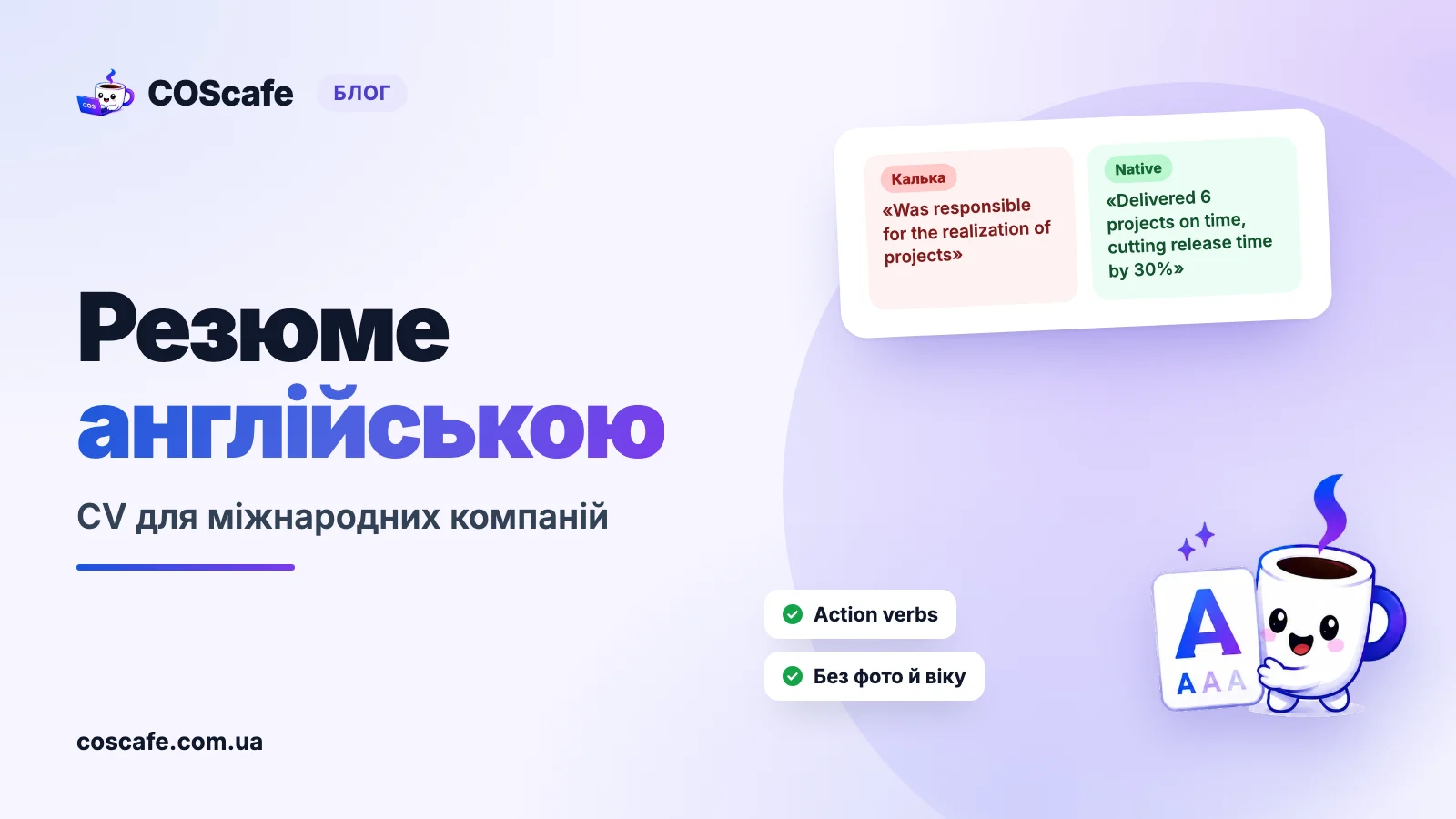
As a recruiter who has spent years reading English resumes from Ukrainian candidates, I keep seeing the same calques. Grammatically they're often correct, but a native speaker wouldn't write that way:
- Responsible for testing of the application.
- Took part in the development of the new module.
- Work with clients and their requests.
- Have experience in Excel and accounting programs.
- Main tasks: making reports, control of payments.
- Tested a mobile banking app across 3 releases, cutting critical bugs in production by half.
- Built the payment module that now processes all card transactions in the app.
- Handled 40+ client requests weekly with a 24-hour response time.
- Automated monthly reporting in Excel, saving the team 6 hours per month.
- Prepared weekly financial reports and reconciled supplier payments.
A few more common traps:
- "Took part in", "participated in" — this blurs your role. State exactly what you did.
- "Work" instead of "worked" and mixing tenses within a single block.
- Calque words: "specialist on sales" instead of "sales specialist", "higher education" instead of the degree name (Bachelor's / Master's in…).
- Abbreviations only understood in Ukraine — ФОП, ЗНО, names of government systems. Explain them or replace them with a general description.
Job titles, dates and format
Job titles
Use the title that recruiters abroad will search for, not a literal translation from your employment record. "Провідний інженер-програміст" means nothing to a recruiter in Berlin — "Senior Software Engineer" does. If your official title differs greatly from the market one, you can give both: "Senior Software Engineer (official title: Lead Engineer)".
Dates
Use month + year with the month spelled out: Mar 2023 – Present, Sep 2020 – Feb 2023. Don't write 03.2023 — it reads differently in the US than in Europe and causes confusion. Mark your current job as "Present".
Format
- 1 page for up to about 5 years of experience, 2 pages if you have more.
- One column, simple fonts, no tables or icons — ATS reads them poorly.
- Order: name and headline → contacts + LinkedIn → Summary → Experience → Skills → Education.
- .docx or PDF file, named "Name-Surname-Role-CV".
Summary
Two or three lines under your headline that answer "who you are and what value you bring". Not "Motivated professional looking for new opportunities", but your role, experience, domain and one key result:
- Hardworking and motivated specialist with good communication skills, looking for a challenging position.
- Customer Support Lead with 5 years in SaaS. Built a support team of 8 and cut first response time from 6 hours to 40 minutes.
Write the summary last, once your experience is ready: it's easier to pick out what matters most.
Translating vs. writing from scratch
The most common mistake is to take your Ukrainian resume and translate it sentence by sentence. You end up with Ukrainian logic in English words: duties instead of results, long sentences and odd phrasing.
-
1. Gather facts, not text
For each job, write down: what you did, for whom, with which tools, and what changed after you (the numbers).
-
2. Look at 2–3 job postings in English
Note the words companies use to describe your role. Those are exactly what the ATS and the recruiter are looking for.
-
3. Write in English from the start
Each bullet follows the formula "verb + what + result". Short sentences are easier to write and to read.
-
4. Check for calques
Read it aloud: if a phrase sounds like a translation, rephrase it more simply.
If you're building a resume for IT, the structure an ATS expects is covered in the article "An IT Resume in 2026: a sample structure that passes the ATS". And your LinkedIn headline and About should be in English too — the recruiter will see them alongside your resume.
Sample experience block in English
Say our candidate Andrii, a marketer, is applying for a Performance Marketing Manager role at an international e-commerce company:
Performance Marketing Manager — Online furniture store, Kyiv, Ukraine
Jan 2022 – Present
• Launched paid search and social campaigns for 4 new markets, reaching break-even in 3 months.
• Reduced cost per acquisition by 27% by restructuring campaigns around product margins.
• Built a weekly performance dashboard used by the CEO and sales team.
• Managed a monthly ad budget of $40K and a team of 2 specialists.
Every bullet is an action plus a result. No "responsible for", no "participated". And you can describe the company briefly if its name means nothing to a foreign recruiter.
If you'd rather not write in English from scratch, COScafe lets you create an English resume: you upload your current resume, answer a few positioning questions, and the system writes the text directly in English rather than translating it. Dates, links and achievements are taken only from your answers and your old resume. You can then get the finished version reviewed through a recruiter's eyes for free.
Summary
- Photo, age, marital status and full address removed.
- Every experience bullet starts with an action verb and includes a result.
- Market-standard job titles, dates as "Mar 2023 – Present".
- The resume is written in English from scratch, not translated literally.
- 1–2 pages, one column, no tables.