
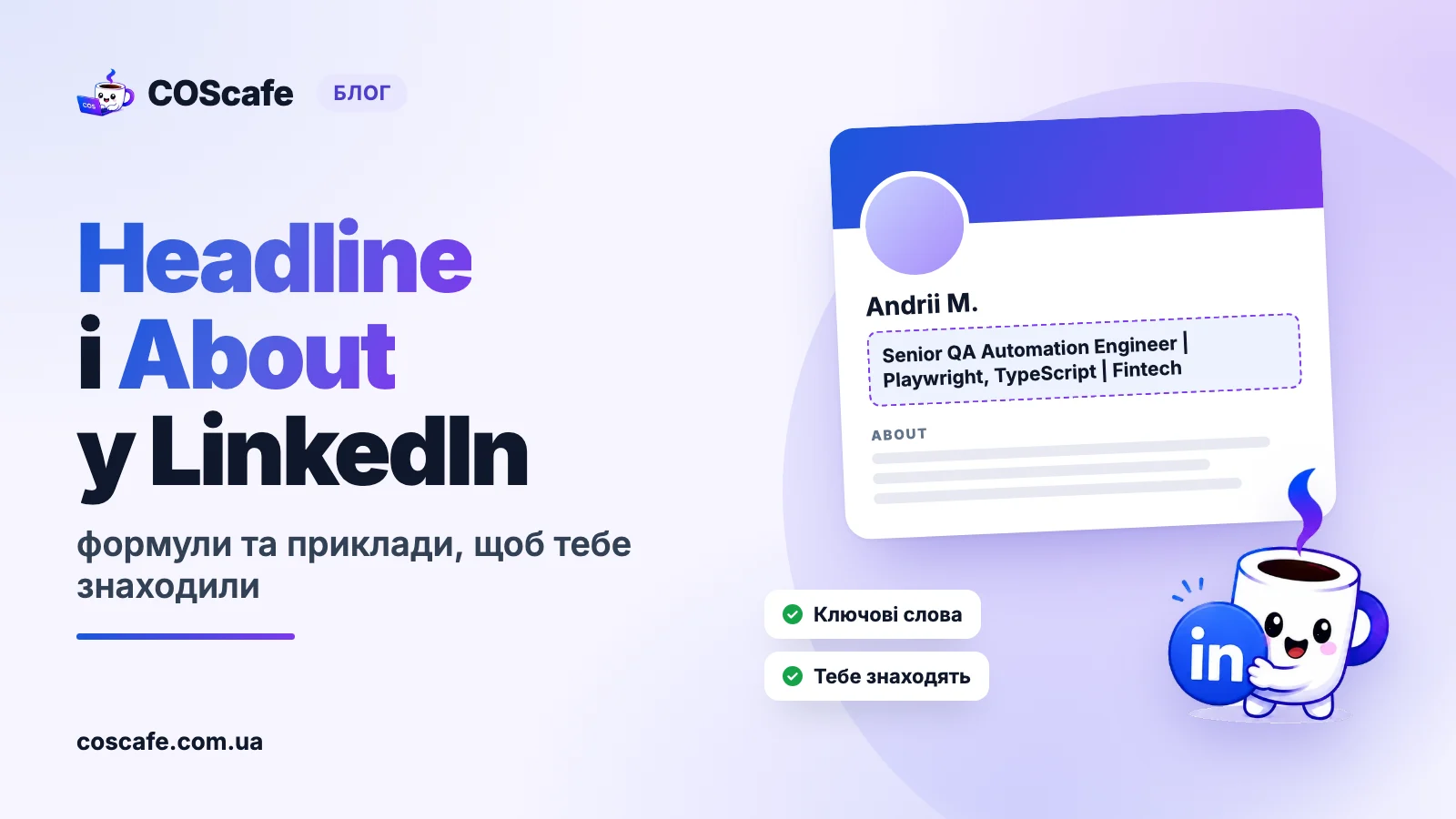
Your LinkedIn Headline is your role, key skills and domain in one line — because those are the exact words recruiters use to find candidates. Your About is a short five-part text: a hook, who you are and who you work for, 2–3 achievements with numbers, skills as keywords, and what you're looking for. Below you'll find the formulas, ready-made examples for different roles, and a full About sample.
How recruiters find you on LinkedIn
A recruiter doesn't scroll through profiles at random. They type the role and a few skills from the job posting into search, add filters — location, language — and look through the results. In the results each profile takes up a single line: photo, name, headline. If your headline doesn't contain the words the recruiter typed, your profile either won't show up at all or will get lost in the list.
That's why the headline is the single most important field for search. The recruiter opens your About only afterwards, once the headline caught their eye and they want to understand who you are. As a recruiter, that's exactly how I read an About: I look for the answer to "does this person fit my role?" in the first two or three lines. For more on what a recruiter manages to notice on your profile in just a few seconds, see "LinkedIn profile for an IT specialist: what a recruiter sees in a few seconds".
4 LinkedIn Headline formulas
The examples below are in English: if you're looking for work at international companies or with foreign clients, recruiters will search for you using English words. The separator — " · " or " | " — is up to you; what matters is that the line reads easily.
-
Role + stack + domain
The baseline formula that works for almost everyone. Example: Middle QA Engineer · Manual & Automation (Playwright, API) · Fintech
-
Role + stack + result
When you have a strong number a recruiter will get without any context. Example: Backend Developer · Go, PostgreSQL, Kafka · Cut API latency by 60%
-
Role + who you serve + the value you bring
For roles where the business impact matters. Example: Product Manager · B2B SaaS · From discovery to launch, 3 products shipped
-
Target role + what you already can do
For juniors and career changers. Example: Junior Frontend Developer · React, TypeScript · 2 commercial projects
A few more examples across different roles — to show how the formula maps onto real experience:
- QA: QA Automation Engineer · Java, Selenium, REST Assured · E-commerce
- Project / Product Manager: Project Manager · Agile, Scrum · Outsourcing, teams of 10–25
- Developer: Senior Full-Stack Developer · Node.js, React, AWS · Healthtech
- Sales: B2B Sales Manager · SaaS · Closed deals in EU & US markets
- Junior: Junior Data Analyst · SQL, Python, Power BI · Ex-accountant
Notice the "Ex-accountant" in the junior example: your previous experience isn't something to hide. It tells the recruiter why you're more interesting than the next junior, and it adds one more word for search.
Headline mistakes that make you invisible
- Looking for new opportunities
- Open to work
- Software Engineer at Company X
- Passionate, motivated, team player
- QA
- Middle QA Engineer · Manual & API testing · Mobile apps
- Data Analyst · SQL, Python, Tableau · Retail
- Software Engineer · Python, Django · Logistics
- Customer Success Manager · B2B SaaS · Onboarding & retention
- QA Engineer · Manual, Postman, SQL · Edtech
- "Looking for opportunities" and "Open to work" in the headline. That's not how recruiters search. This is the spot where your role and stack should be. LinkedIn has separate settings for your job-search status.
- Only a job title and company name. This is the default headline — LinkedIn fills it in for you. It tells people where you work, but not what you can do.
- Adjectives instead of skills. No one searches for "passionate" or "motivated."
- Too short. Every word is one more chance to show up in search. Use the space.
- Internal job titles. "Quality Wizard" or "Ninja Developer" won't get you found. Write your role the way it's worded in job postings.
What to put in your About: the five-part structure
Your About isn't an autobiography or a copy of your CV. It's a short text that should answer three questions for a recruiter within half a minute: who you are, what you've already done, and whether you fit their role. Here's a structure that works:
- The hook — your first sentence. LinkedIn shows only the beginning of your About and hides the rest behind "see more." The first sentence should be about you specifically, not "I am a passionate professional."
- Who you are and who you work for. Your role, years of experience, domain, and the type of companies or teams: product, outsourcing, startups, enterprises.
- 2–3 achievements with numbers. What changed because of you. Keep it short, one per line — it's easier to read that way.
- Skills as keywords. Your stack, tools and methodologies — in the same words used in job postings for your role.
- What you're looking for + contact. Which role, in what format, and how to reach you.
A full About example
The example is in English — because LinkedIn profiles are most often read by international recruiters, and English gets you more views. The details are fictional and the person is made up:
I help fintech teams release faster without breaking payments.
QA Engineer with 5 years in product companies — mobile banking and payment services, teams of 6–15 people. I build test processes from scratch and automate what slows the release down.
• Built an API and UI regression suite of 600+ tests — regression went from 3 days to 4 hours
• Introduced a bug triage process that cut critical bugs in production by half over two quarters
• Onboarded and mentored 3 junior QA engineers
Skills: manual & automation testing, Playwright, TypeScript, Postman, REST API, SQL, CI/CD (GitHub Actions), Jira, TestRail.
Open to Middle+/Senior QA roles in product companies, remote or hybrid. Feel free to message me here.
What works here: the first sentence says which problem this person solves, even before "see more." The second sentence gives the recruiter the role, years, domain and team size. The achievements come with numbers and no fluff. The skills sit in a single keyword line. At the end there's a specific role and work format, not "open to any opportunities."
Length — 120–200 words is enough. A long About rarely gets read to the end, and a short one without numbers doesn't convince.
Which language to write your profile in
If you're looking for work in IT, at international companies or in a foreign market — write your headline and About in English. Recruiters search for candidates using English words, and even Ukrainian companies with international clients often run their search in English.
If your market is purely Ukrainian and not tied to IT, a Ukrainian profile works too. LinkedIn lets you add a second-language version of your profile, but the primary language should be the one people will actually search for you in. Not sure? Look at the language of the job postings you're applying to — and write in that one.
What to do next
Your headline and About are the entry point to your profile. So that an interested recruiter doesn't get let down further on, the rest of your profile has to back up what you say at the top. And for how to use LinkedIn actively — messaging recruiters, finding roles through your network rather than just waiting around — read "How to find a job through LinkedIn, not just by applying to postings".
If you'd rather not write it from scratch, COScafe offers LinkedIn profile generation: from your materials and your answers to positioning questions, it produces your Headline, About, experience, 20–30 skills and a checklist of what to set up on your profile — all in English. The facts are taken only from your own materials — all that's left is to double-check and paste them in.
- Your headline contains your role, key skills and domain — in the words used in job postings
- Your headline has no "Looking for opportunities," "Open to work" or empty adjectives
- The first sentence of your About makes sense without "see more" and speaks about you specifically
- Your About has 2–3 achievements with numbers, a skills line and what you're looking for
- Your profile language is the one recruiters will search for you in