

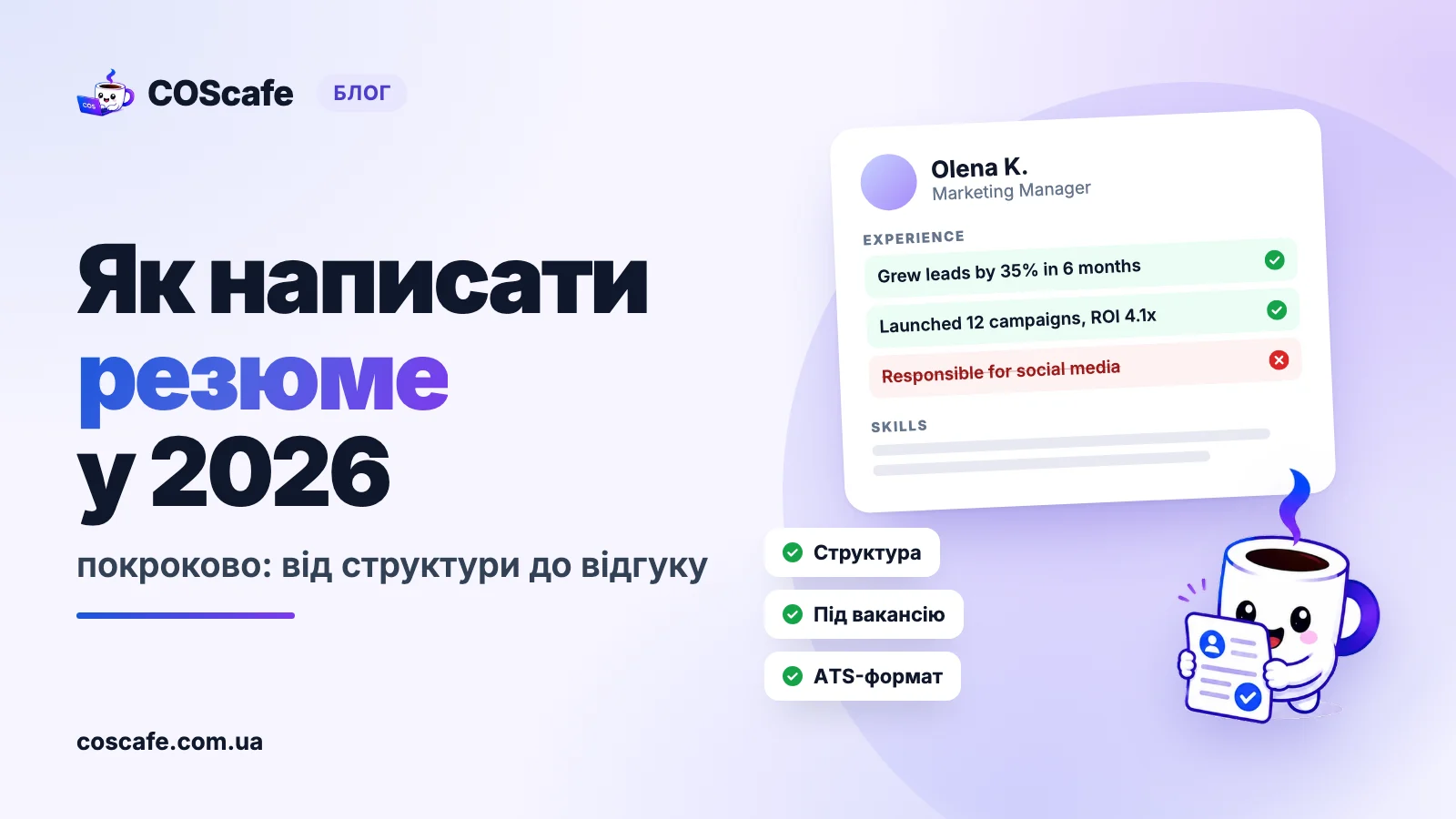
To write a CV in 2026, make it one page with a clear job-title headline, a short summary, experience framed as "action + result," and skills that match the words in the job posting. Before every application, tailor the headline, summary, and order of bullet points to the specific role. Below is what to put in each section, how to phrase your experience, how to get past the ATS, and a checklist to run through before you hit send.
CV structure: what goes where, and in what order
A recruiter doesn't read a CV from top to bottom — they scan it. So the order of the sections should match what they need to know first: who you are, the role you're after, and what you can already do. This structure works for any profession — from an accountant or sales manager to a designer or logistics specialist.
-
Header
Your name, the role you're applying for, city and work format, phone, email, and a link to LinkedIn or your portfolio. No photo, date of birth, or marital status unless they're specifically requested.
-
Summary — 2–3 sentences
Who you are by role, how many years of experience you have, in what field, what you're strong at, and one key result.
-
Work experience
From your most recent job back to the oldest. Company, role, dates, and 3–5 "action + result" bullet points.
-
Skills
Tools, software, methods, languages — the ones you actually use and that are mentioned in the job posting.
-
Education and courses
Keep it short: institution, field of study, year. List only courses relevant to the target role.
If you're in IT, there are a few specifics — your stack, projects, and seniority level in the headline. We covered them separately in the article "A CV for IT in 2026: an example of a structure that passes the ATS." Here are the general rules that work for everyone.
What to write in each section
Headline and header
Under your name there should be a specific job title, not "looking for work" or "specialist." Recruiters and search engines look for the name of the role, so write it the way it appears in job postings: "B2B Sales Manager," "Accounts Payable Bookkeeper," "Project Manager." If you're applying for several different roles, make several versions of your CV rather than one "one-size-fits-all" version.
Summary
These are three lines that answer the question "why should I keep reading?" Skip "responsible, communicative, stress-resistant" — these words are in every other CV and prove nothing.
- A responsible and communicative person, a fast learner, looking for an interesting job with room to grow.
- B2B Sales Manager, 4 years in building-materials distribution. I run the full deal cycle — from cold contact to signing the contract. Over the past year I brought in 12 new corporate clients.
Work experience
The most important section. For each job, write 3–5 bullet points, and each one should describe not a duty but what changed because of you. How to phrase it — in the next section.
Skills
Be specific: "1C: Accounting," "Excel — pivot tables, VLOOKUP," "CRM systems," "English B2." A "team player" line is out of place here — soft skills are better shown through examples in your experience.
Education
If you already have a few years of experience, education goes at the end and takes up one or two lines. If you're a student or recent graduate, move it higher and add internships, your thesis project, volunteering — that's experience too.
How to describe your experience: the "action + result" formula
As a recruiter, I see the same mistake in most CVs: people copy out their job description. "Was responsible for…," "worked on…," "handling of…" — that's about the process, but a recruiter wants the result. The formula is simple: what you did (a past-tense verb) + what it achieved (a number, a scale, or an outcome).
- Responsible for warehouse inventory.
- Worked on the company's social media.
- Customer service.
- Moved warehouse inventory from paper to spreadsheets — cut stocktaking from three days to one.
- Ran the brand's Instagram: in six months the audience grew from 2K to 9K, and the first orders came in via Direct.
- Served up to 40 customers per shift and earned the highest service rating in the chain for the quarter.
Strong verbs to start a bullet: launched, reduced, increased, set up, automated, negotiated, trained, implemented, reworked. Weak ones — "participated in," "helped," "was responsible for" — hide your contribution.
How to tailor your CV to a job posting
One CV for every job works worse than it seems. Tailoring doesn't mean rewriting everything each time — 10–15 minutes per job you're interested in is enough.
- Pick out 5–7 key requirements from the posting — tools, tasks, skill names.
- Check whether those words appear in your CV — in the same wording. If the posting says "inventory management" and yours says "warehouse work," swap it.
- Rework your summary for this role: the first line should match who they're looking for.
- Reorder your experience bullets so the most relevant ones come first.
- Cut the clutter — bullet points that say nothing about this particular role.
If you apply to different roles often, it's handy to keep a base version and make a copy for each posting. In the COScafe resume builder you can add the job description, and the CV is assembled for it from your old CV and your answers to positioning questions — with no invented achievements or dates.
ATS-friendly formatting: making sure the system can read your CV
Many companies first run applications through an ATS — a system that parses your CV into fields and searches for keywords. If it can't read the file, a human may simply never see it. What helps:
- A single column, with standard section headings: "Work experience," "Education," "Skills."
- A standard font, no text inside images, icons, or text boxes layered over graphics.
- No tables used to lay out the page — the system may mix up text from neighboring cells.
- Contacts in the main body, not in the header or footer.
- Dates in a single format: "03.2022 — 09.2025" or "March 2022 — September 2025."
- A .docx file or a text-based PDF (one where you can select the text with your mouse). A scan or an image-based PDF won't be read by the system.
- A clear file name: "First_Last_Role.pdf," not "cv_final_2.pdf."
Common mistakes that stop your CV from being read
- Two or three pages for no reason. One page is enough for most roles; two — only if you have over 7–10 years of experience and it's genuinely relevant.
- A list of duties instead of results. The recruiter never finds out how you're better than anyone else in the same role.
- Vague words with no proof: "creative," "driven," "ambitious."
- Unexplained gaps in dates. A break is fine, but one line ("parental leave," "studying," "relocation") clears up the question.
- Typos and inconsistent formatting: mixed fonts, periods that come and go, dates in three different formats.
- A dead email or an outdated phone number. It sounds obvious, but it happens more often than you'd like.
- A job from 15 years ago described in the same detail as your latest one. Older roles can be collapsed into a single line.
If you're sending out lots of applications and hearing nothing back, this is often the reason. We covered the rest — from applying at the wrong moment to mismatches with your LinkedIn — in a separate article on why no one replies to your CV.
A CV in Ukrainian or English?
It depends on the employer. For Ukrainian companies, a Ukrainian version is usually enough; if the company works with international clients or the posting is written in English, send the English one. The English version isn't a word-for-word translation: job titles, tool names, and the way you phrase achievements need to sound natural to an English-speaking reader. If you need both versions, write the English one separately rather than running the finished text through a translator.
Final checklist before you send
- Under your name — a specific job title, as in the posting.
- A 2–3 sentence summary with one real result.
- Every job has "action + result" bullet points, not duties.
- Keywords from the posting appear in the text — in your own, truthful wording.
- A single column, no tables, images, or text in headers and footers.
- One page (or two, if your experience truly calls for it).
- Dates in one format, with no typos or stray spaces.
- Contacts work and links open.
- A .docx file or a text-based PDF with a clear name.
Want an outside check before you send? A free CV review at COScafe gives you a score from 0 to 100 across three categories through a recruiter's eyes and tells you what to fix first.
Frequently asked questions
How many pages should a CV be?
One — for most candidates. Two — if you have many years of relevant experience and every line on the second page truly matters for this role.
Do I need a photo on my CV?
No, unless the posting specifically requires one. A photo adds no arguments, takes up space, and can get in the way of the ATS reading the file.
How do I write a CV with no work experience?
Move education, internships, academic and volunteer projects, and side gigs higher up. Describe them with the same "action + result" formula: "organized a donation drive for a shelter — collected 300 kg of pet food" — that's experience too, and it shows how you work.
Do I need a cover letter?
Where it's requested or where there's a message field — yes. A few sentences on why this role in particular and what similar work you've already done set you apart from identical applications. You can put together a letter tailored to the posting in the cover letter builder.