


"What's your salary range?" — and this is where most people blurt out a number off the top of their head: a bit lower than they'd like, so as not to scare the recruiter off. The problem is that the market already pays specific money for a specific level — and when the number you pulled from thin air is below the real median, you're simply handing the difference to the company.
If you're a Senior and you're looking beyond Ukrainian companies, there's another nuance: the word "remote" in a job posting doesn't define the range on its own. What defines it is whether you physically stay in Ukraine or actually relocate — those are two different salaries. Let's break down how much IT really pays right now and how to name your range based on numbers, not fear.
How much IT actually pays right now
According to DOU's summer survey (4,541 respondents, May–June 2026), the median after-tax salary on the Ukrainian market looks like this:
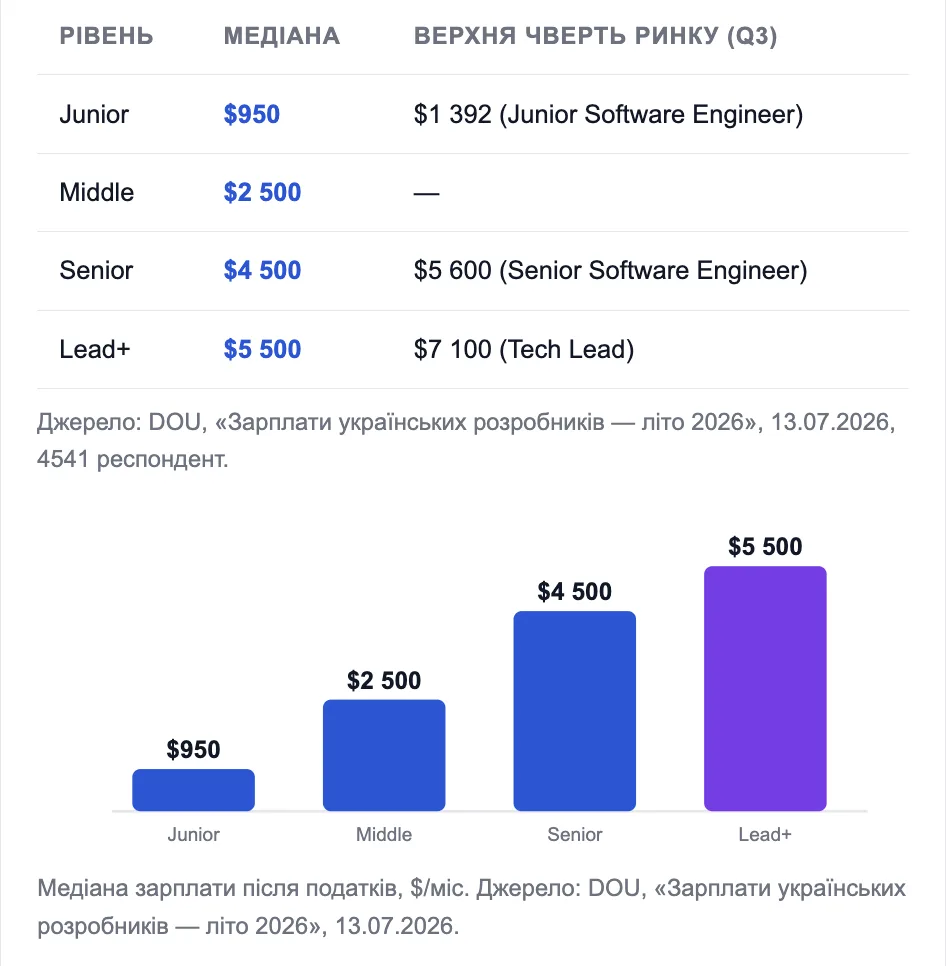
The gap between the median and the market's upper quartile is your real range. If you work through outstaff or outsourcing for a foreign client while staying in Ukraine, this same table remains your benchmark. But if your goal is a role that actually requires relocation, the range is different — see below.
The "remote range in Europe" — why it's trickier than it looks
Here it's worth being blunt: most European and American companies do NOT hire a senior who physically lives in Ukraine as a direct permanent remote employee. The reason isn't qualifications — it's the legal, tax and insurance complications of such hiring, plus the perceived business risk of a country at war.
The same DOU summer survey (4,541 respondents) we used above counts exactly these two realistic scenarios separately:
Source: DOU, "Salaries of Ukrainian developers — summer 2026," 13.07.2026 — the same report as the table above in this article, broken down by company type and by living abroad.
For a Senior who stays in Ukraine, the closest realistic jump above the $4,500 median is an outstaff contract with a foreign client ($4,650, a small premium). A direct B2B/contract arrangement with a foreign company happens too, but there's no large survey with verified numbers for that segment — so there's nothing to confirm a specific range there. The noticeable jump to the $5,200+ level in the DOU data appears specifically among those who physically relocated — meaning the range grows together with relocation, not just with a "remote" label in the job posting.
Why a lowball number costs real money
The principle below works the same for the Ukrainian and the international market — the numbers come straight from the DOU survey (1,930 respondents, December 2025, job changes over the second half of 2025): 19% of respondents changed jobs during that period. Of those, 67% got a raise — on average $600, or 36%. 17% saw no change. And 16% ended up with less — on average $500, or 20% lower.
A video on this topic — Why is it so hard to ask for a raise? A COScafe podcast with a psychologist — about the psychological barrier before the money conversation, not just the numbers.
The picture differs by level: a Junior gains over 60% on average (backend juniors — up to 75%), a Middle — over 40%, a Senior — over 20%. But the risk of ending up in the red is real too: those who lost in salary got on average 32% less at the Junior level and 16% less at the Senior level. That's why a range protects you both ways — from a lowball number and from an inflated one that the company simply won't confirm.
One more nuance from a later DOU analysis: Juniors who joined a company less than a year ago earn on average less than colleagues of the same level with longer tenure inside the company. Experience doesn't sell itself — you have to name it out loud, together with the number.
The market right now: where hiring is actually active
During the same week that Netflix cut around 1,000 people (≈6% of the team, mostly product, engineering and legal), a job tracker across 78 tech companies counted 16,045 open positions. Some companies open a lot of remote roles specifically: at OpenAI, 527 of 804 open positions are marked remote, at Snowflake — 172, at ElevenLabs — 129 of 147 positions. Honestly: these numbers show the overall appetite for remote hiring, not that every one of these roles is ready to consider a candidate physically in Ukraine — location and the right to work should always be checked in the job description, not assumed from a "remote" tag.
Separately: Stripe and MongoDB were expanding their EMEA teams that very week (an Account Executive at Stripe, Sales at MongoDB) — not engineering roles, but a sign that hiring in the region hasn't stopped even amid the headlines about cuts at Netflix. In Ukraine, demand for candidates hasn't disappeared either: per DOU, in Q3 2026 about 38 candidates competed for a single opening. For a Senior who stays in Ukraine, it's this outstaff/outsourcing market with foreign clients that's the most realistic channel for an above-median range — not subscribing to remote postings from megacorps with unknown availability for a UA location.
Sources: dev.to (15.10.2026), FastCompany (16.10.2026), DOU — IT labor market review for Q3 2026 (published 07.10.2026).
How to name a number without selling yourself short
- Prepare a range, not a single number: the lower bound is the median for your level from the DOU table above, the upper bound is closer to Q3 if you have concrete results from previous roles.
- First figure out whether the role requires an actual move or whether you stay in Ukraine (outstaff/outsourcing for a foreign client): if you stay — the DOU median above is your benchmark; if it requires moving — the range is the one in the relocation section. Confusing these two numbers means either scaring the recruiter with a figure from the wrong market, or underselling yourself.
- If you can, let the recruiter name a range first and build from there; if they ask you directly, name a range, not a single point.
- Tie the number to results, not to wishes: what specifically changed in the metrics or processes thanks to you in your previous role.
- Don't count on years in the profession to raise the number on their own — the recruiter only sees what you spelled out in your CV and profile.
Phrasing your results is exactly the weakest spot in most CVs, because a CV is written once "for everything" and isn't adapted to a specific role. On the COScafe platform, the positioning exercise (32 questions) helps pull those results into clear wording before the conversation about the number — not after.
More on a CV structure that shows results rather than duties — in the article "A CV for IT in 2026: an example of a structure that passes ATS." And examples of real interview questions — in the article "Interview question examples, the job market and career strategy from scratch."
By the way, the COScafe platform now has a "Job history and tracking" tab with search analytics: a funnel from application to offer, responses by source, the status of each application. When you see your real conversion — how many applications reach a call and how many reach an offer — it's easier to gauge how strong your position is before naming a number in an interview.
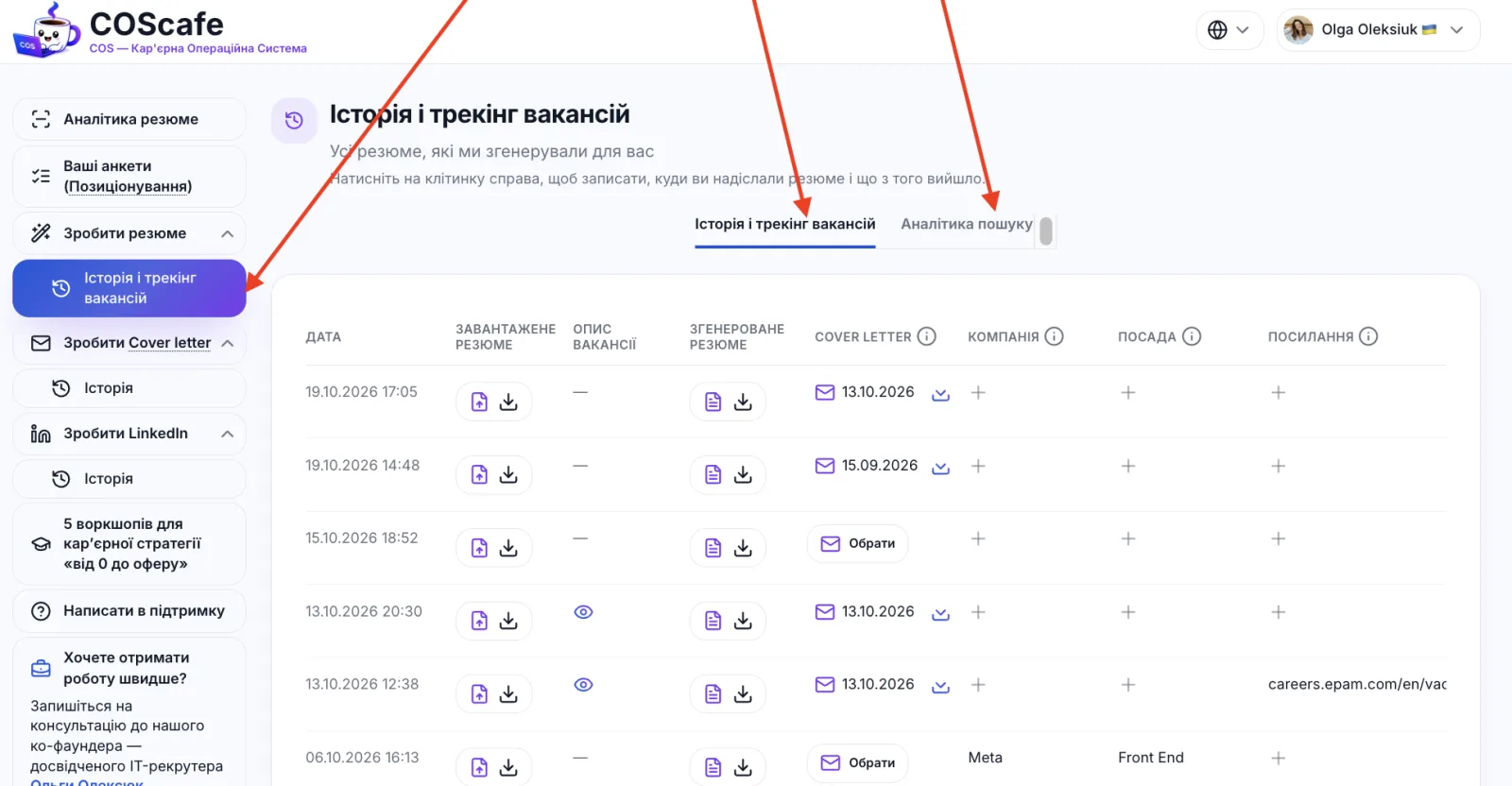
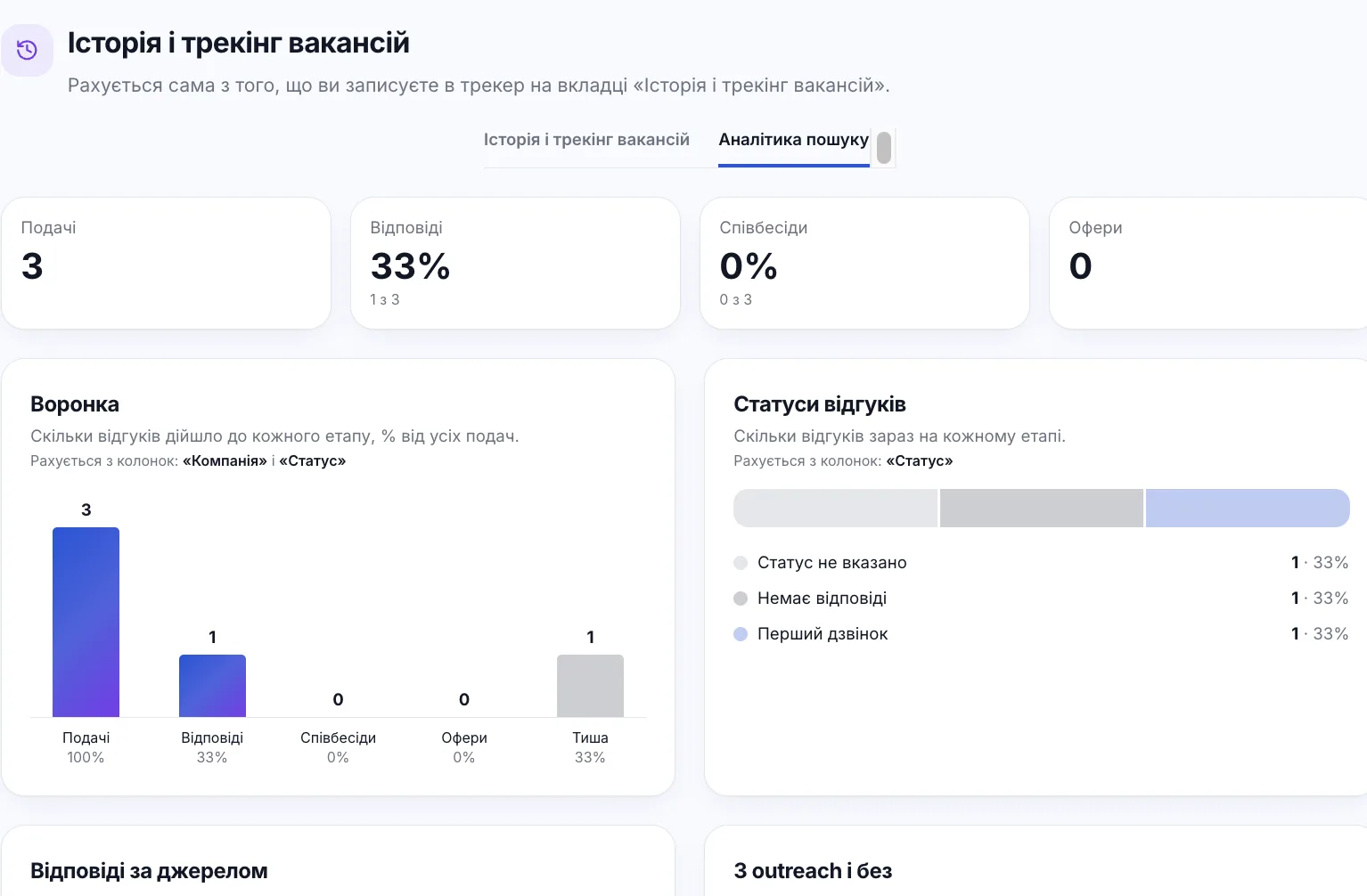
Screenshot of the COScafe platform interface, the "Job history and tracking" → "Search analytics" tab.
Imagine: a year from now you sit down for another interview and try to remember what range you named last time and what results you used as your argument. On the Lifetime plan, your CV, positioning profile and the entire preparation history are saved forever — along with 5 lessons on building a career strategy, including the interview. You prepare for the next negotiation not from scratch, but from what you've already built. Anyone already on Lifetime gets every new platform feature automatically, at no extra cost.
Frequently asked questions
Is it better to name an exact number or a range in an interview?
A range. An exact number easily becomes a ceiling — a company rarely offers more than the figure you named, while a range leaves room for discussion and shows that the number is grounded in the market, not made up on the spot.
What should I say if they ask about salary on the first call?
Name a range tied to the median for your level from real data (the table above), and add that the final figure depends on the scope of tasks and the results the company expects.
How much do Junior, Middle and Senior roles in IT pay right now?
On the Ukrainian market, per DOU (summer 2026): the median for Junior is $950, Middle — $2,500, Senior — $4,500, Lead+ — $5,500, after tax.
Can you earn a "European" salary while staying in Ukraine?
Rarely as direct permanent remote hiring — most foreign companies avoid that arrangement because of legal, tax and insurance complications. The realistic scenarios for a Senior in Ukraine are outstaff/outsourcing for a foreign client (DOU median $4,650) or relocation (median among Ukrainians abroad — $5,200, per the same DOU survey). A noticeable jump in the range usually comes together with the move, not with the word "remote" in a job posting.
Does salary really grow when you change jobs?
In 67% of cases — yes, by 36% on average. But 16% ended up with less, which is why a range, rather than a single desired number, protects against both scenarios.
Should I tell the recruiter I have other offers or interviews?
When they ask, it's no reason to panic — it's a signal that the company is already weighing how in-demand you are on the market. An honest, brief answer without details ("yes, I have parallel processes") usually works in favor of your range better than denial — the key is not to turn it into pressure or an ultimatum.
This article was prepared by the COScafe team based on the DOU survey "Salaries of Ukrainian developers — summer 2026" (13.07.2026, 4,541 respondents, including a breakdown by company type and by living abroad), the survey "How much salaries of IT professionals grow when changing jobs" (14.05.2026) and the IT labor market review for Q3 2026 (07.10.2026), as well as hiring data from dev.to and FastCompany for 15–16.10.2026.